
Every industry, corporation, and entrepreneur faces problems worth solving.
But not all opportunities for innovation are worth pursuing as a startup.
Market mapping is one of the most powerful tools in our toolkit — along with our customer-discovery process, market-sizing exercises, and go-to-market strategy — that helps us determine a problem-solution fit in a market and informs early-stage business models and product development.
In other words? Market mapping is a crucial step in our venture-building process.

What is market mapping?
Market mapping involves analyzing the competitive landscape to learn if a new product or service could better serve a particular audience. Evaluating market trends, pinpointing strengths and weaknesses of current product offerings, and assessing customers' perceptions of those solutions all help would-be startup builders identify potential entry points and paths to profitability in said market.
The resulting market map of this work is a visual representation that provides insights into:
- What differentiates a proposed startup idea from incumbents already in the space
- The target customer persona(s) who could be better served with a new solution
- The competitive density of the market (i.e., number of companies in the vertical)
- Revenue that could be generated by and the likely growth rate of a new startup
- Potential partners and investors who could help accelerate business growth
But arguably the biggest insight emerges from the critical questions asked during the mapping process itself, the answers to which reveal not just where opportunities exist but also a hypothesis on how to capture them.
Building the market map: A 4-step process
Our approach to market mapping is entirely problem-focused. We move beyond solely traditional industry-wide analysis. This enables our team to focus on the distinct pain points of a specific customer base.
We also run market mapping alongside customer discovery.
This allows our Build team to have in-depth chats with potential customers to discover and validate their Jobs to Be Done. (That is, their functional, social, and/or emotional needs).
This synchronized process allows us to prioritize vital yet unmet needs that are felt by a large group of people. From there, we can work with partners to craft solutions that directly address the most critical gaps in that market.
"We're partnering with organizations who want to innovate," Alloy Partners Managing Director Ryan Larcom recently shared with PRINT Magazine. "So what we're first trying to figure out is the theme."
Ryan noted that means asking questions like:
- Where, specifically, do we want to focus this new opportunity?
- Is it away enough from the core that it won't get sucked back in?
- Can we really differentiate from what exists in the market today?
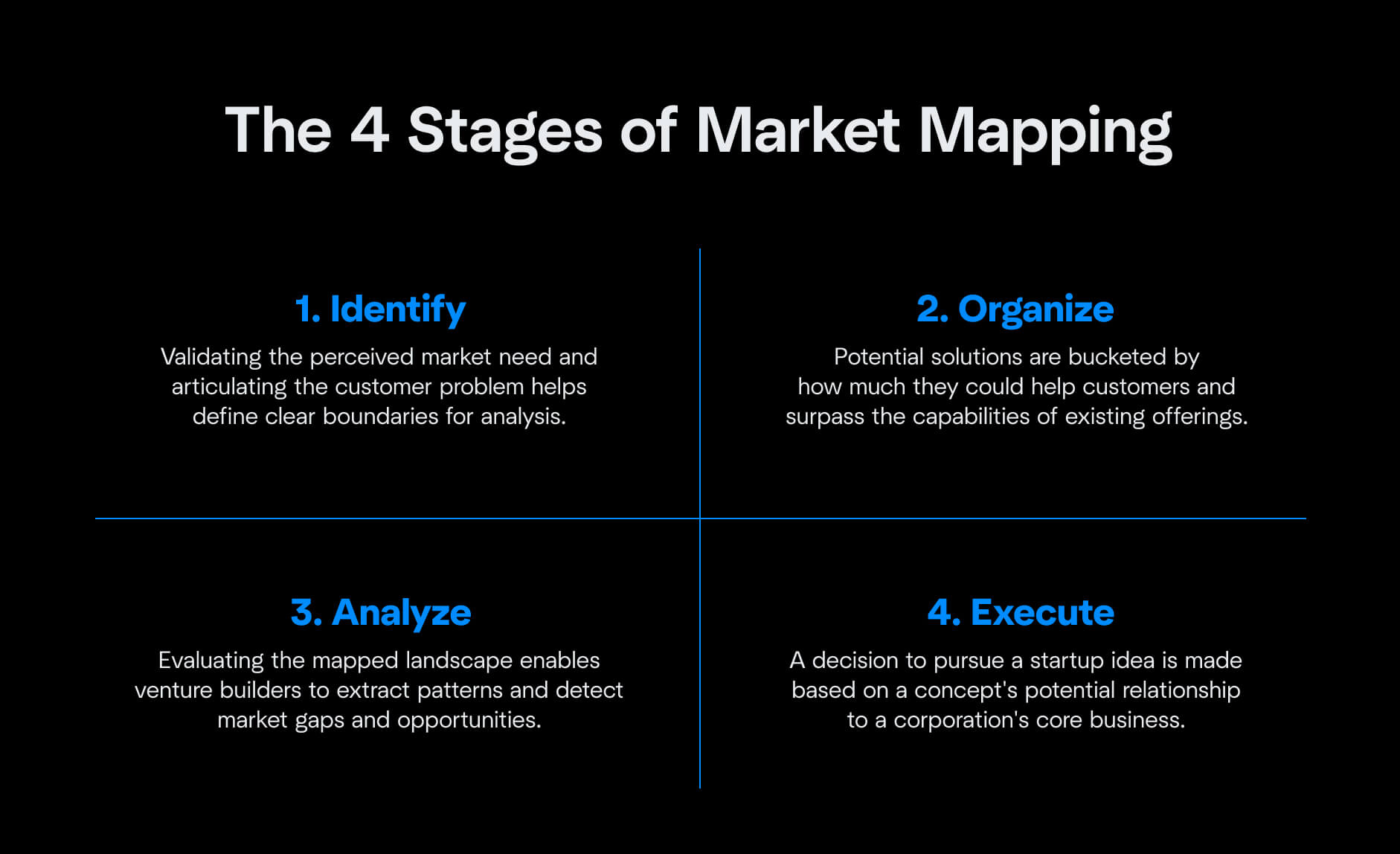
It also means following the four essential steps of any successful market-mapping process.
1) Identify
Market mapping begins with validating the market need. This defines clear boundaries for analysis. With the problem and people who experience it most acutely articulated, we ID the solutions customers use currently.
The goal is to be generative in this step. We look at incumbents, emerging startups, and point solutions. Customer discussions and secondary desk research help build an initial market map for our team to work with.
Key questions we ask during this stage include:
- Customer pain point. Who exactly is experiencing a problem?
- Jobs to be Done. What goal is that audience trying to achieve?
- Existing solutions. What products do they rely on most today?
Example
A common Job to Be Done for many large enterprises is, "Help human resources more efficiently onboard employees while ensuring a consistent experience for new hires and compliance."
Looking at the current landscape, incumbents include established HRIS solutions such as Workday, ADP, and Oracle and traditional IT-workflow tools like ServiceNow. Emerging tools are BambooHR, Rippling, and Sapling, while point solutions like DocuSign handle some new-hire tasks.
Many companies still rely on DIY and non-consumption approaches. That means they use a blend of spreadsheets, email, shared drives, and basic checklist tools to tackle this Job to Be Done.
2) Organize
With an initial market map, we can then organize solutions based on how they help customers make progress. This classification goes beyond basic company categorization to learn the true competitive landscape.
The criteria and questions can be adjusted based on corporate innovation goals. That said, we loosely follow the business model canvas. This work mirrors a competitive landscape analysis.
Key questions we ask during this stage include:
- Customer segments. Which customer segments are being served vs. underserved?
- Value proposition. What unique benefits or trade-offs does each solution offer?
- Business model. How do different players capture value in the market?
- Go-to-market strategy. What channels and pricing strategies are being used?
Example
Analyzing the employee onboarding landscape, the market shows distinct patterns in how solutions create value:
- Some companies prioritize reduced manual work and compliance tracking.
- Others focus on improving time-to-productivity and employee experience.
Most solutions fall into clear categories. These include document management systems, workflow automation tools, employee experience platforms, IT provisioning solutions, and compliance-focused systems.
- The major HRIS like Workday and ADP focus on compliance and documentation. Notably, they offer 'all-in-one' solutions with enterprise licensing and per-employee pricing.
- Emerging players like BambooHR and Rippling emphasize employee experience and automated workflows. These offerings use module-based pricing with subscription models.
These providers' GTM strategies vary a lot. Incumbents use existing enterprise relationships and direct sales teams. Meanwhile, newer entrants often use product-led growth and inside sales models targeting HR leaders directly.
3) Analyze
The next step is analyzing the mapped landscape to extract patterns and detect gaps and opportunities. This evaluation reveals market dynamics and paths forward for building, testing, and validating business concepts.
Key questions we ask during this stage include:
- Timing. What market conditions or trends create an opportune moment for launch?
- Competitive advantages. What unique advantages could a new entrant leverage?
- Unmet needs. What customer segments are currently underserved in the market?
- Business model. What monetization and distribution strategies prove successful?
Example
In analyzing the employee onboarding landscape, many key patterns start to emerge.
Market timing appears favorable as hybrid work models and talent competition drive demand for better onboarding experiences. Clear gaps exist in department-specific customization and remote compliance capabilities.
The best business models in this space combine subscription-based pricing with implementation fees. Meanwhile, their GTM strategies increasingly favor product-led growth complemented by enterprise sales teams.
The most promising opportunities appear in addressing unmet needs of hiring managers supporting onboarding flows.
4) Execute
The final step is determining how to pursue identified advantaged-startup opportunities based on their relationship to the corporate venture-building partner's core business. This helps match the right startup options with the optimal execution methods.
Key questions we ask during this stage include:
- Core fit. Can this opportunity be built using existing capabilities and business units?
- Capability gaps. What kinds of new skills or tech would be needed to succeed?
- Speed requirements. How quickly must you move to capture this opportunity?
- Resource needs. What investment structure and organizational model best support this initiative?
Example
In the employee onboarding landscape, we can consider executing based on a corporate partner's fit with existing capabilities.
- Core opportunities could involve enhancing current HRIS platforms with improved workflows and integrations leveraging existing IT infrastructure and HR processes at the company.
- Adjacent opportunities exist in partnering with HR tech startups to add specialized capabilities like AI-powered documentation or remote-first experiences without having to build internally.
- The most transformative opportunity lies in creating a new, external venture focused on department-specific onboarding automation. This would address the persistent issue of customization that incumbents and point solutions struggle to solve.
This latter option requires a startup approach to rapidly experiment with new tools and business models outside of traditional HR systems and could solve a problem for a larger market outside the specific corporation.
Benefits of market mapping: What it tells us
A well-executed market map paints a clear picture of the competitive landscape and reveals valuable insights that can inform the development of a new business concept.
That includes the target market entry points, MVP features to build first, efficacy of the business model, and ideal GTM launch timing.
Market mapping isn't just a theoretical framework. It's a powerful tool that can drive informed decision-making and increase the likelihood of near-term success and long-term resilience for new business ventures.
By leveraging relevant, accurate, and timely industry and competitor data, corporations can validate business concepts, shape MVP development, and build compelling businesses that address real market needs.
Reveals market gaps before you build
The most immediate benefit of market mapping is seeing where existing solutions fail specific customer segments. Not every gap is worth filling — but a market map lets you see the white space, so you are making a deliberate choice about where to compete rather than stumbling into an overcrowded segment. For venture builders, this is the difference between building into a fight and finding the angle nobody else has claimed yet.
Validates — or kills — the concept early
Most failed startups did not fail because they built the wrong product. They failed because they chose the wrong market or misread the competitive dynamics. Market mapping surfaces those dynamics before you commit capital. When the analysis shows three well-funded incumbents already solving the exact problem you have in mind, that is not a failure — that is the map working as intended.
Shapes MVP feature prioritization
Understanding how incumbents create value tells you what not to build first. If every existing player offers compliance tracking but none delivers an intuitive onboarding experience, you know where your first sprint should focus. Market mapping converts competitive white space into product roadmap guidance before a single line of code is written.
Clarifies the competitive moat
What does a new entrant have to be meaningfully better at to win? Market mapping forces this question by requiring you to place every existing solution on the dimensions that matter to the customer. The answer to "what gives us an unfair advantage here" becomes much clearer once you have mapped who is doing what, for whom, and at what price.
Surfaces timing and partnership signals
A market map shows not just who is in the space, but which players are growing, which are struggling, and which adjacent operators might make natural partners or early investors. Market timing — when to launch and when to wait — is easier to read when you can see the trajectory of the whole ecosystem, not just individual competitors.
Limitations of market mapping
Like any analytical tool, market mapping has real constraints worth understanding before you invest in the process.
A gap in the market is not the same as demand
White space on a map does not prove customer intent. A segment can be underserved because competitors chose not to serve it — and often for good reasons: thin margins, low willingness to pay, or extreme fragmentation. Market mapping reveals the gap; customer discovery has to confirm whether demand actually exists before you build toward it.
The map is a point-in-time snapshot
Markets move. A competitor that looks dormant today may launch a new product tomorrow. A market map loses accuracy the moment it is finished, which is why the most effective teams treat it as a living document — updated as customer discovery runs in parallel — rather than a one-time deliverable handed over at the start of a project.
Only as reliable as the research behind it
The quality of a market map depends entirely on the quality of the inputs. Secondary desk research produces a starting hypothesis, not a verdict. Customer discussions and primary research are required to validate the patterns the map suggests. A map built on incomplete data leads to confident wrong decisions, which is more dangerous than no map at all.
It does not replace customer discovery
Market mapping and customer discovery answer different questions. Mapping tells you what exists; discovery tells you what customers actually need and are willing to pay for. Running them simultaneously is the point — the map generates hypotheses, and discovery tests them. A market map without discovery is informed speculation about a landscape you have only read about.














































































.avif)