.avif)
According to the Mack Institute’s 2025 Corporate Venturing Report, 23% of the leading global corporations use venture building as part of their corporate venturing strategy.
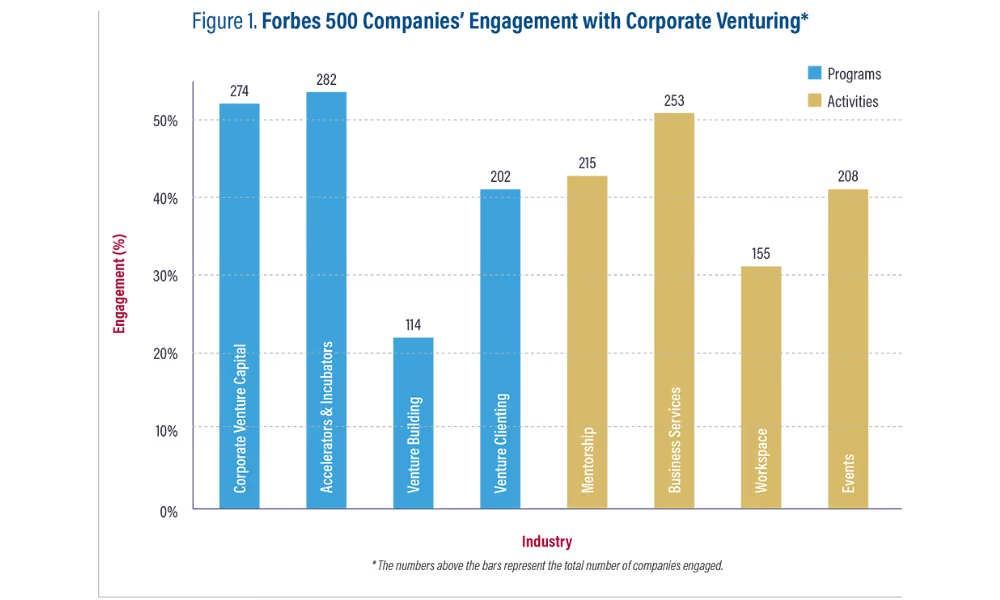
As a leading venture builder, we love to hear that and hope that stat continues to grow. Unfortunately, among the 23% that run a “venture building” program, many are distorting the definition of venture building, and most are only pursuing internal venture building. They aren’t launching external startups and practicing venture building in the way that the most successful venture building programs are.
Internal Venture Building vs. External Venture Building
Most corporations don’t understand the difference between building internal ventures and building external ventures or when you should use each approach. Below we’ll dive into the differences and value of each.
Internal ventures are about executing what you already know. They are internal business units, products, R&D, etc. Building external ventures and external startups is about discovering what you don't know yet. Corporations are built for the former; startups are designed for the latter. The best venture building programs do both, using clear decision criteria to route opportunities to the right structure.
When to Build Internally vs. Externally
Internal venture building is best for strategically critical opportunities. These are initiatives where the corporation's future depends on success. In these cases, maintaining control and leveraging existing assets, resources, and competencies gives you a decisive advantage over startups. Corporations excel at scaled execution and capital efficiency. When you know what to do and just need to execute, go internal.
External venture building works best for strategically interesting but non-essential opportunities. These are the ideas with big potential but real uncertainty. The path forward isn't clear. Multiple solutions are possible. Startups thrive in this environment. They learn fast and experiment freely. They don't get bogged down by enterprise constraints. When you need to discover the solution, not just execute it, go external.
The key is triage. Ask two questions upfront: Is this strategically critical or just interesting? Is this an execution problem or a learning problem? Route each opportunity accordingly. This alignment drives success.
Elliott Parker describes this in more detail in this recent clip from the Advantaged Podcast, There’s No Such Thing as a Corporate Startup: What Companies Get Wrong About Venture Building:
Why Venture Building Should Be External
For the biggest impact and value to an organization, venture building really needs to be pointed at launching external ventures. They need to leverage teams that ideate, launch, and scale new ventures beyond the parent company’s bureaucracy and culture. This externalization grants freedom, agility, and access to bold entrepreneurial talent, enabling rapid experimentation that wouldn’t survive corporate inertia or risk aversion.
It also pushes an innovation team closer to their true purpose within an organization — to learn and embed those learnings back into the mothership. Launching more experiments (i.e. startups) at a rapid pace, gives a large corporation the best chance to learn.
Launching external ventures also helps compartmentalize risk: unsuccessful projects do not tarnish the corporation’s brand or balance sheet.
If your venture building program only builds internal ventures, you're missing the point entirely. The real magic happens when you launch external startups at pace. That's where learning accelerates, risk disperses, and breakthrough innovation emerges. It's time to expand your definition of venture building. Don’t just execute. Learn. Disrupt. Win. It’s time to build ventures that move your company (and the world) forward.