The people running IT, legal, and risk management at your company are doing exactly what they should be doing.
That's the problem.
What's blocking AI transformation inside most enterprise organizations is a structural incompatibility so fundamental that no change management program, no innovation czar, and no internal AI task force is equipped to solve it. The infrastructure built to protect your core business from risk is the same infrastructure that makes experimentation at AI speed impossible.
Clayton Christensen said it precisely:
"The very processes and values that constitute an organization's capabilities in one context define its disabilities in another context."
He wrote that in 1997. It has never been more relevant than it is today.
The System Is Working Perfectly
Scaled enterprises are optimized for one thing: executing reliably on what already works. That is a remarkable achievement. The processes, governance layers, and review structures that characterize a large organization are not accidents. They were built, refined, and hardened over decades to protect billions of dollars of revenue and millions of customer relationships. They do that job well.
They are also the wrong operating system for building what comes next.
A company that built multi-billion dollar revenue on operational excellence has every incentive to protect the processes that produced it. Eighteen months of pilots makes sense when the stakes are high and the approval layers are doing exactly what they were designed to do. The system is correctly optimized for a different problem than the one in front of you.
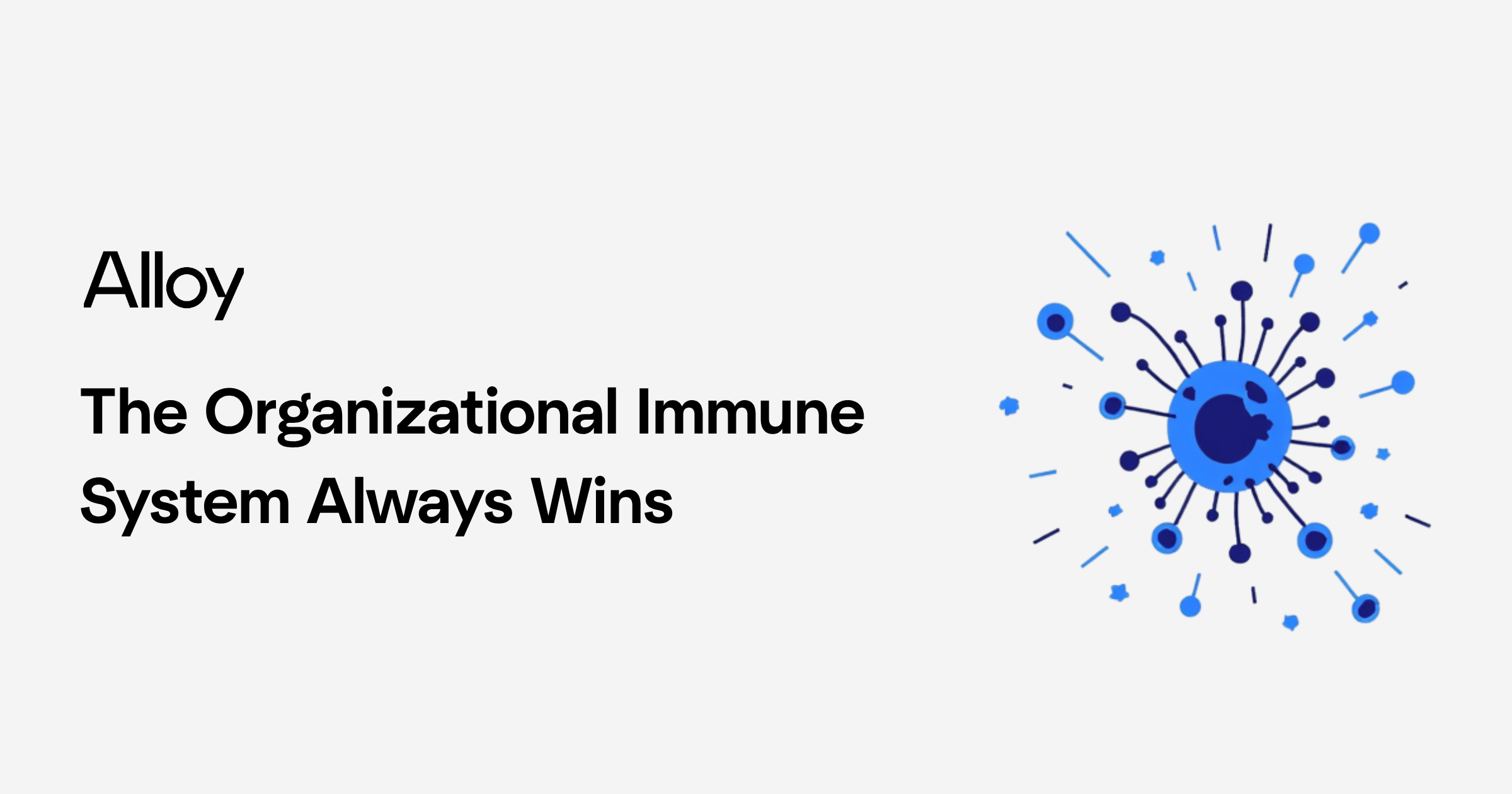
Said differently: you cannot debug your way out of this. You can replace every tool, hire every AI consultant, and reorganize your innovation team twice, and the underlying physics will not change. A healthy immune system does not distinguish between a threat and an opportunity. It identifies the foreign body, and it neutralizes it.
The Immune System Doesn't Know It's Rejecting the Cure
This is where Christensen's framework runs deeper than most people apply it. The innovator's dilemma isn't only about technology trajectories. It's about organizational biology. The same capabilities that make large organizations durable, that let them operate at scale without chaos, that give them the consistency to serve millions of customers reliably, are the same capabilities that will reject anything moving at startup speed.
Governance exists to slow down decisions. Legal exists to surface risk. IT exists to protect the integrity of systems that the whole enterprise depends on. None of these functions are adversaries. They are, by design, friction-generating mechanisms. In the context of running a core business, friction is a feature. In the context of building something new at AI speed, friction is fatal.
The result is a pattern that plays out at nearly every large organization attempting AI transformation internally: teams form, budgets are allocated, pilots are announced, and then the organism does what organisms do. Korean lawyers need to review the data agreements. IT won't approve the tools. Risk management wants another six months of review. Three years and tens of millions of dollars later, the scoreboard reads: zero shipped.
This is, ironically, competence. The organization is protecting itself exactly the way it was designed to.
The Correct Architectural Answer
Corporations have known this for decades. It is why subsidiaries exist. It is why spin-outs exist. It is why the most innovative internal bets inside large companies have historically been the ones that got carved out, given different governance, and insulated from the immune system of the parent. The architectural answer to organizational antibodies is to route around them.
The AI revolution taking place at the moment makes this move available at a scale and speed that wasn't possible before.
One entrepreneur. 1,000+ AI agents. Nine companies built simultaneously in two months. That is not a thought experiment. That is what our team at One Health Studio built, and it changes the math on what "routing outside" actually means.
The old version of going outside was a spin-out: assemble a small team, give them a separate entity, wish them luck. It took 18 months to get to a real signal. The new version is an agentic venture studio: bring an entrepreneur with the right incentives and autonomy, deploy an architecture of agents across every domain from regulatory intelligence to market analysis to product development, and generate validation data in 90 days. The immune system has nothing to reject because the work was never inside the organism.
What This Looks Like in Practice
One company in our pipeline right now is a global manufacturer. Multi-billion dollar revenue. A serious innovation investment in the tens of millions of dollars. Multiple years of genuine effort, and the ideas that mattered most still hadn't moved.
Not because the ideas were bad. Not because the leadership wasn't committed. Because every time an idea got traction, the same sequence played out: legal needed to review the data arrangements, IT raised integration concerns, risk management wanted another round of evaluation. The immune system activated, every time, exactly as designed.
The conversation we're having with them now is about taking specific ideas outside. The core business stays intact. The experiments that have been sitting on the shelf get a different environment to run in, one where the immune system has nothing to activate against. In a true startup operating context, with the right entrepreneur and the right agentic infrastructure, 90 days produces validation data, early product signals, and customer conversations that were never possible internally. Something concrete to take to the board. That's not a promise. That's just what startup speed looks like when the organism isn't fighting it.
The Ideas on Your Shelf
Every scaled organization has them. Ideas that surfaced in strategy reviews and went nowhere. Adjacent markets that everyone agreed were interesting but couldn't get prioritized against the core. Product variants that made sense but had no internal champion willing to fight the approval gauntlet. They are not bad ideas. They are ideas that require a different environment to survive.
Christensen's prescription for this situation was not to try harder inside the organism. It was to build an autonomous organization with different governance, different incentives, and different processes. In 2026, that autonomous organization comes pre-loaded with 1,000 agents and the infrastructure to run your entire idea backlog in parallel.
The window for this is narrower than it looks. The AI moment is not slowing down to wait for internal alignment. The organizations that will emerge from this period with new capabilities and new revenue streams are the ones that found a way to act now, at the speed the moment requires, with the right infrastructure to make it real.
Going outside is the correct architectural answer, validated by thirty years of evidence about how scaled enterprises actually succeed at disruptive innovation. The AI model just makes it faster, cheaper, and available to more ideas simultaneously.
If you have ideas sitting on that shelf, let's talk about what we'd do with them.











































.avif)