The reasons for venture building at scaled organizations vary. But the approach aims to solve four problems:
- Customer problems. Find a way to provide a new form of value to existing customers, as their wants and needs change over time.
- Business problems. Give new tools to teams across your company so they can deliver greater value in a quick and efficient manner.
- Market problems. Keep a close eye on changing business environments and within certain industries to identify emerging opportunities.
- Strategy problems. Develop new options for future growth (i.e., a new revenue stream), learning, and exploration into new verticals.
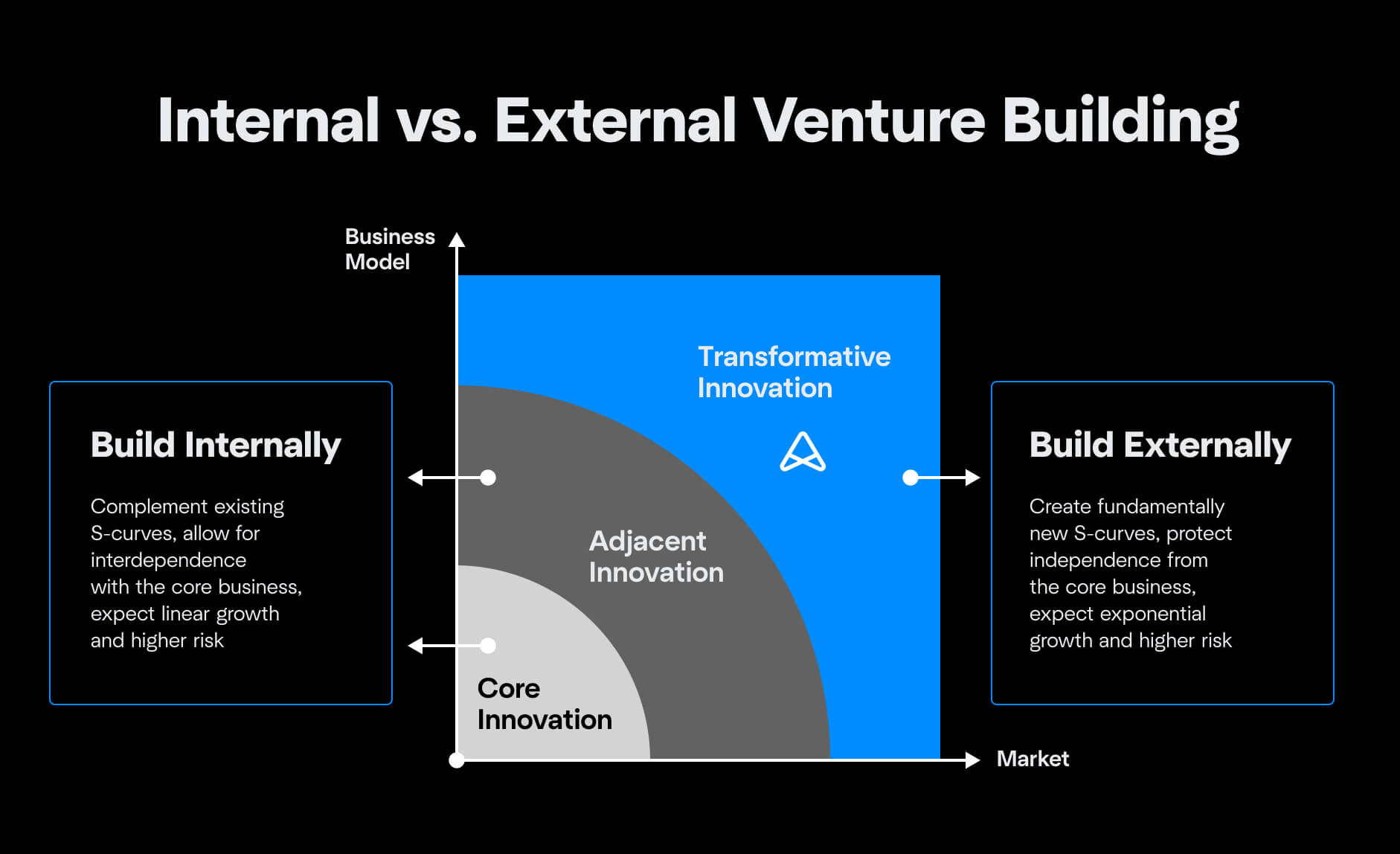
Whether you want to tackle one or more of these issues to create new companies separate from your core business, just know that attempting to do so in-house isn't always an ideal avenue.
Your organization's best bet to build a truly transformative startup, and give it the best chance of long-term success, is working with a proven, external venture-building partner.

The (many) pros of working with an external venture-building partner
The modern venture-building process is fast-paced, yet structured and methodical. It requires a problem-first approach: moving quickly to uncover and deeply understand unmet needs before trying to identify solutions. But that's not all it requires.
It also requires the right outside partner who can keep innovation programs moving full steam ahead and avoid engaging in innovation theater.
Pursuing innovation outside the core of the business, from inside its structure, is almost always impossible. Outside partners who have actually launched independent startups can break ideas free of those constraints. Speed goes up. So does the likelihood of success. Scaled organizations that want real results have to put real capital behind external venture building.
They can create new startups that attract outside venture capital interest by penetrating new markets, disrupting existing (and ineffective) business models, and scaling rapidly.
"One of our central hypotheses is that scaled organizations are missing out on enormous value by dramatically under-investing in their opportunity to create new, independent businesses."
Translation?
Working with an external venture-building team to solve big problems through startup creation (a process that involves concept exploration, product-market fit analysis, idea validation, and business planning) is how you attract top talent and VC investment.
(And prevent your business from engaging in the illusion of innovation.)
As noted, the "why" behind scaled organizations' external venture-building aspirations vary. But there are a few common reasons our corporate, university, and state government partners often share with us.
1) You have aggressive business goals to meet that prevent a focus on any transformative innovation initiatives.
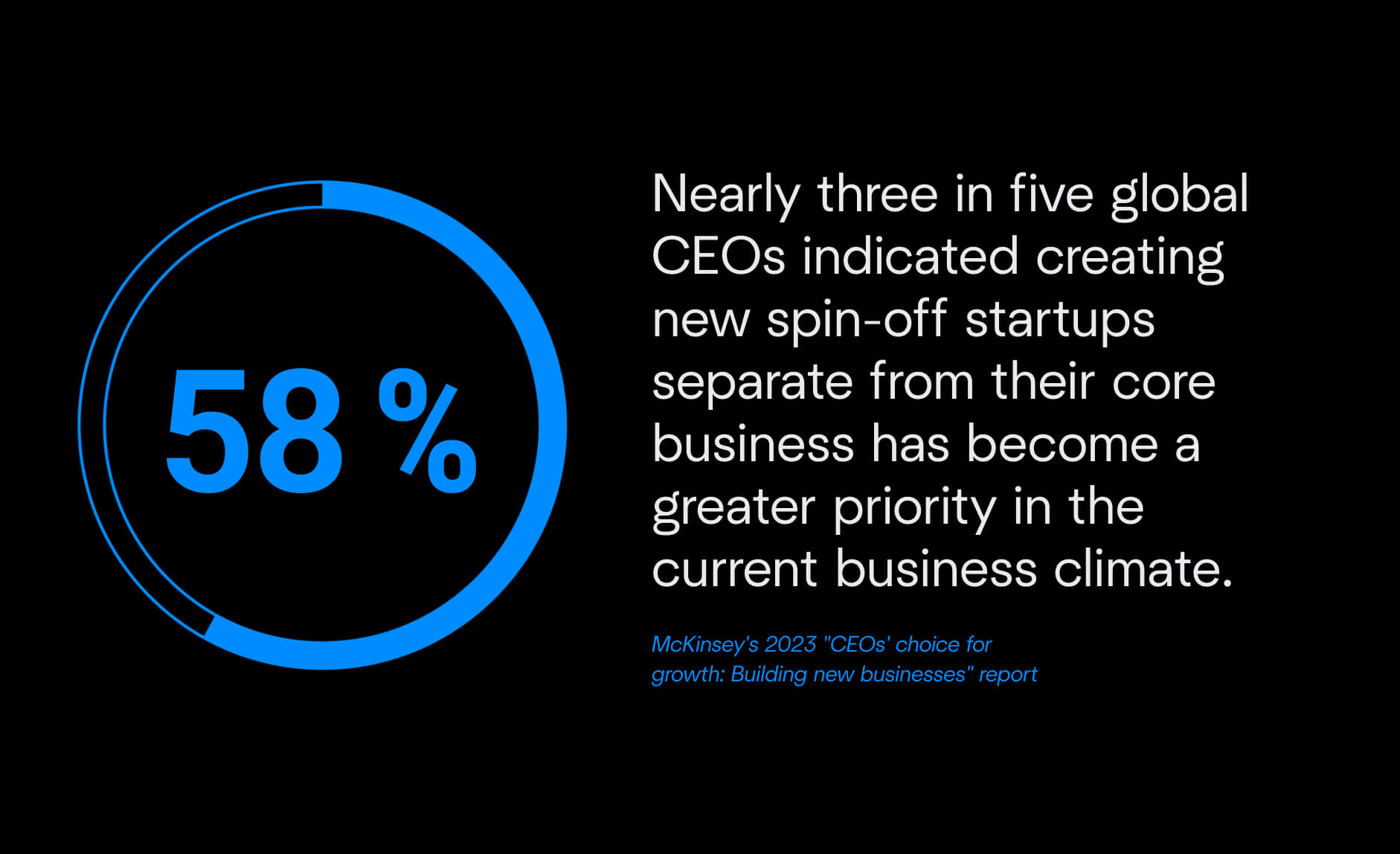
Half of CEOs worldwide polled by McKinsey in 2023 cited venture building as a top-three priority. Yet many renege on corporate innovation programs intended to launch new startups. (Often months after greenlighting them.)
Why? Because, in their minds, priorities tied to the core business operations supersede any perceived "bonus" transformative innovation activities that may not yield the desired fruits of their innovation team's labor.
Commitment is an underrated component of successful venture building today. Many investors "have the patience to see the real returns come through," McKinsey Sr. Partner Paul Jenkins noted.
However, some C-suite and board members are all too willing to pull the plug on innovation programs, including those around startup creation, before they've had the chance to execute on high-potential ideas.
External venture builders can expedite this venture-building process to ensure that new startups launch quickly.
This fast turnaround, in turn, appeases high-level stakeholders and investors with tendencies to question (and shut down) business initiatives separate from the core products and services.
2) You want a 'forcing function' that can keep your venture-building process on the rails and on schedule.
Speaking of seeing new startups created from scratch in a matter of months, sticking to arbitrarily set timelines often proves difficult for in-house innovation labs. (Especially when there's no C-suite-mandated deadline for discovery.)
Internal innovation teams tasked with launching lean startups tend to take their time. Give them free rein from leadership to examine multiple problems and potentially dozens of ideas tied to those issues, and timelines stretch even further.
There's nothing wrong with a meticulous, detail-oriented approach to evaluating, validating, and de-risking new startup ideas.
But outside venture-building partners can act as a hard-line forcing function.
In other words? They can ensure agreed-upon, high-growth concepts advance from one stage to the next. What's more, they can make sure the best startup idea is moved into the business planning phase.
External venture-building teams guide their partners through the startup creation process. At Alloy Partners, that means set-in-stone milestones and deadlines to stay on track with launching NewCos.
That means your organization can see real-time progress in relation to the overarching venture-building strategy and avoid hitting roadblocks that can cause red flags in the eyes of your corporation or university leadership.
3) You need GTM guidance, exposure to a broader partner ecosystem, and a repeatable venture-building playbook.
Venture building is often seen as a one-off, standalone process in which partners and co-founders are eventually left to hire team members, secure outside funding from VCs, and navigate legal processes on their own.
At Alloy Partners, that's not the case.
Our team not only defines customer and industry problems, shape value propositions for prospective companies, and drafts delivery and economic models to advantage startups and their founders from the get-go, but also:
- Works on go-to-market plans with founding teams. Creating the brand story and identity, aiding with finance and accounting needs, offering legal and administrative assistance, and helping with operational logistics are just some tasks we tackle for partners during GTM planning.
- Secure initial talent, customers, and investors. Our team sources, interviews, and hires top founding talent whose skill sets complement those of the CEOs. Then, we work with these leaders to acquire their first customers, and prepare them to engage in potential VC opportunities.
- Offers a blueprint for repeatable startup development. For corporations and universities that want to scale company creation, we can help them build venture studios. Learnings from the first startup launch can inform enhancements to subsequent venture programs. That means faster time to market with highly impactful NewCos.
When you invest in startup creation through the venture studio model, you get a team singularly focused on one thing: understanding problems and building companies to solve them.
At our company, that means weeks of exploration, dozens of customer interviews to surface audience insights, market-strategy validation, and solution engineering.
This work helps our venture-building partners sharpen their points of view on the problem at hand and enables us to discover how we can collectively create advantaged startups to solve them.





























































.avif)