Picture the best team you’ve ever worked with. Now imagine they showed up on Day One of every single company you built. They're fully briefed, already aligned, ready to execute. No onboarding. No knowledge gaps. No waiting six months to find the right hire while your market window closes.
That’s not a fantasy.
That’s the operating model we designed.
We started One Health Studio with a simple but radical premise: the #1 killer of venture studio companies isn’t bad ideas or bad timing. It’s the brutal, compounding cost of assembling teams from scratch, over and over again. The answer wasn’t to hire faster. It was to reinvent what a “team” could be. The result is the first AI-native venture studio — where every company launches at full strength, where speed to deliverable is measured in hours not months, and where a concept becomes a Series A business plan in days.
There’s a question every venture builder is afraid to answer honestly: If money were no object, what team would you build?
Not the team you could afford. The one you’d actually need: the full-stack dream roster that transforms a thesis into a Series A-ready company. For most studios, that team is a fantasy, assembled piecemeal over months of hiring, onboarding, and knowledge loss. That lag time doesn’t just slow companies down. It kills them.
We decided to solve this differently. We built an AI venture studio — the first of its kind — where that dream team isn’t a milestone you work toward. It’s the starting line. Every company in our portfolio launches with a complete team on Day 1. Time to full team: one working session. Cost to add a company: near zero. Knowledge retention: 100%. Because agents never forget.
Every venture studio dies the same way: they run out of team. Not runway. Not ideas. Team.
The gap between the talent you need and the talent you can actually hire has quietly killed more promising companies than bad markets ever will. We kept asking the same question: If money were no object, what team would you build? We realized we were asking it wrong. The right question is: What if you never had to choose?
Every company we launch gets a full team on Day 1. Not a skeleton crew. Not “we’ll hire as we grow.” Full strength — from the first working session. Because you can’t wait to hire. The work needs to start on Day One.
I want to explain what this looks like in practice, why it works, where it fails, and what I think it means for how venture building actually gets done from here.
Why One Health Matters
I think it would help to start with some extra context on our studio and One Health. One Health is the scientific framework recognizing that the health of people, animals, and the environment are deeply interconnected. Approximately 75% of emerging infectious diseases are zoonotic, originating in animals before crossing to humans. The studio builds companies at these intersections, where breakthroughs in one domain create outsized impact across all three.
The portfolio reflects that breadth and ambition: breakthrough companion animal therapies, AI-powered clinics, soil health, sustainable food systems, and pharmaceutical manufacturing.
AI as Operating System, Not Add-On
Built as a multi-partner studio, with Elanco Animal Health and the State of Indiana among its founding collaborators, the studio has produced nine concepts spanning biotech, AgTech, and health technology, all powered by a proprietary AI agent architecture that fundamentally changes how companies are created.
What distinguishes One Health Studio from conventional venture studios is structural. Every concept launches with an AI workforce from Day 1. The studio’s agent swarm architecture, coordinated by a principal intelligence orchestrator, routes work across seven domain pillars: regulatory and clinical, market and competitive intelligence, financial and fundraising, marketing and brand, product and engineering, operations and legal, and knowledge and tools. We have assembled a production infrastructure of 1,133 AI agents across seven operational pillars. These agents don’t advise. They work: drafting regulatory submissions, analyzing patent landscapes, building marketing campaigns, generating proposals, and monitoring FDA, USDA, and EPA guidance in real time.

How the Swarm Is Built
The methodology is four steps, and the first one is the most important.
Step one: design the org chart you would build if cost were NOT a constraint. For each concept at One Health Studio, I ask: if I had unlimited capital and could hire anyone, what does the ideal team look like? For a cat biotech company working on RNA interference, that means a regulatory affairs specialist with FDA CVM and INAD experience, a lab manager, a quality director, a CDMO relationship manager, and several PhD-level scientists with specific subspecialties. I write that org chart before I think about agents at all.
Step two: write actual job descriptions for each role. Not summaries. Real job descriptions, with specific required expertise, defined responsibilities, and clear scope. Just as you would if you were going out to hire these people.
Step three: encode each role as an agent. You define the persona, load the relevant knowledge base, provide access to tools, and specify the organizational reporting structure. These agents are deliberately narrow. The immunologist agent is not helpful if you ask it about synthetic chemistry. But ask it about monoclonal antibodies and it may have 10 or 15 sub-agents of its own and give you something genuinely excellent. The specificity is the point. A single agent or small group of agents using a large language model with a general prompt runs into context window limitations fast, and quality degrades and costs skyrocket. A structured hierarchy of narrow, specialized agents scales, while avoiding prompt degeneration and hallucinations.
Step four: connect the agents into a chain of command. Just like in a human company, information flows up through reporting hierarchies. I interface with the orchestrator agent for each company — the equivalent of a CEO. The orchestrator breaks my task into components, distributes work to manager-level agents, and those agents assign it further down. I am rarely in contact with anything below the orchestrator level.
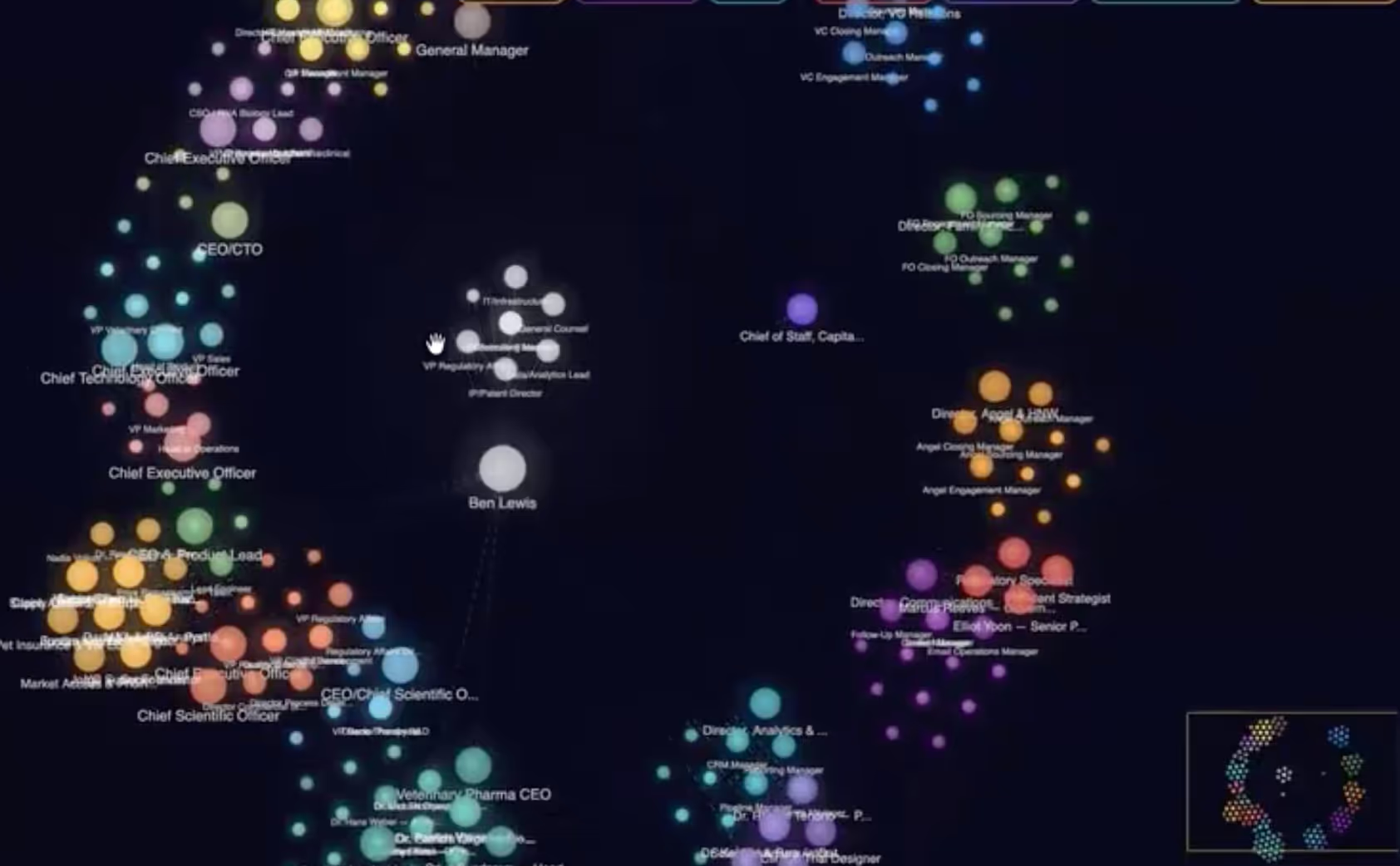
The swarm I rebuilt a few weeks ago started at roughly 40 agents. Within two days it had grown past 300. It now sits above 1,000. Part of that growth is deliberate on my part. Part of it happens while I sleep. Every night, a cron agent reviews the day's work, identifies coverage gaps, and proposes new agents. I review the proposals in the morning and approve the ones that make sense. They are in production by that afternoon.
What Is Still Hard
I want to be direct about the limits, because they are real and the hype around AI makes it easy to paper over them.
The agents cannot take physical action. They cannot run an experiment, move samples between facilities, or establish personal relationships. That sounds obvious, but it matters enormously when you are building companies in fields like veterinary medicine or agtech, where the work eventually requires a lab, a human expert who can validate a finding in person, and sometimes a warm body in a state Medicaid office to have a conversation that no agent can have for you.
I called this the "warm body stage" in a recent team conversation, and it is real for every company in the portfolio. The point at which you need actual people depends on the company. For some, it is sooner. For others, the agents can carry you further before you need to staff up. But it is always coming.
The agents also make mistakes. My comparison is to junior associates at a law firm: roughly 90% of the output is solid, and 10% is wrong. That ratio means the human-in-the-loop is not optional. At One Health Studio, agents cannot send external emails without approval, cannot push to GitHub, cannot schedule external meetings on their own authority. They can think and analyze and produce autonomously. They cannot act without sign-off.
The economics are new and nobody has a clean accounting framework for them yet. I am spending roughly $2,000 a month for the productive output of something between 100 and 300 people, depending on how you count. That number will grow as the swarm does. But the comparison to fully burdened human headcount for the same scope of work is not even close.
One more honest limit: the agents are not strong at original ideation. The right six people around a conference table would still outperform a swarm of 200 agents at reliably identifying 10 white space areas in a particular vertical. The agents are extraordinarily good at execution once direction is set. The original insight, the problem worth building a company around, still belongs to the humans. The agents are how you act on that insight faster and at lower cost than was previously possible.
Why This Changes How Studios Work
Most thinking about AI in venture building treats it as a productivity layer. AI helps the team move faster through the same process. It drafts the memo. It summarizes the research. It generates the first version of a document so someone can edit it faster.
What I have built is structurally different. This is not a faster version of the old model. It is a different architecture for what a studio is.
The classic bottleneck in early-stage company building is the team. You cannot afford the team you need before you have revenue, and you cannot get revenue before you have a team. Every venture studio learns this constraint and builds around it.
A swarm-based architecture breaks the constraint at its root. You can have a full virtual team for each company on day one: regulatory specialist, general counsel, CMC expert, data analyst, each with deep domain knowledge and a defined role. Not a one-size-fits-all generalist, but a narrowly specified expert. The cost fits inside an early-stage studio budget. And the quality of the output, in the domains where agents work well, is high enough to move companies forward meaningfully.
The constraint that remains is the human's capacity. You become the bottleneck, not the AI team. And that is a much more workable problem.
What I Think This Means
The gap between where studios like One Health are operating and where most large organizations are thinking about AI is significant. During the conversation where I shared this with the Alloy team, the observation came up that corporations are still wrestling with questions like who in the organization is accountable for making decisions about agent deployments, while I rebuilt my entire swarm over a weekend.
That gap is not a failing on the corporate side. Large organizations have real security obligations, regulatory requirements, and existing infrastructure that cannot simply be turned off. Those constraints are legitimate. But they also define the opportunity for a studio model that can move at startup speed on their behalf, using an architecture they could not build internally.
What we are discovering in the build is that AI-native venture building is not a future state. It is the operating model we are using right now.
One venture studio. Nine companies (and more on the way). One human co-worker. 1,000+ agents working 24/7/365 (and the swarm will add more tonight). No sick days. No unexpected employee turnover. No complaints. Just execution.
The architecture powering One Health Studio isn't exclusive to it. Alloy is now deploying this agentic venture building model across all of our studios and corporate partnerships, giving organizations a new way to build companies at a pace and scale that wasn't possible before. If you're interested in exploring what it looks like to build in the age of AI, get in touch.





























.avif)