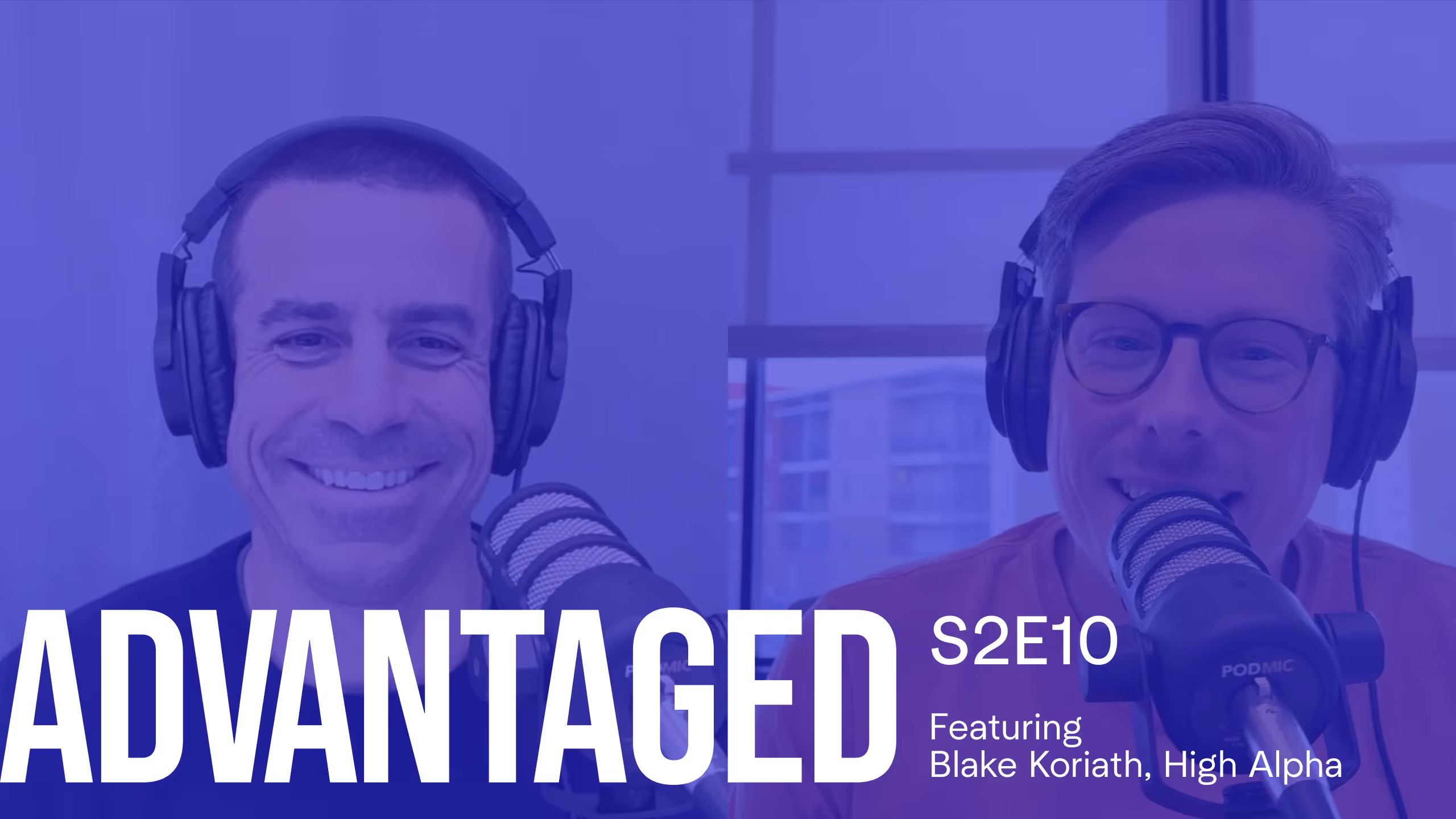
High Alpha's annual SaaS Benchmarks Report is a defining resource for founders and operators across B2B software. We partnered with High Alpha on this year's report and brought High Alpha partner and CFO Blake Koriath onto the Advantaged podcast to discuss insights and takeaways from the 2025 report (their ninth edition).
Our discussion had a sharp focus on AI's impact: not just as a product feature, but as the operational backbone of tomorrow's software businesses. We broke down headline trends, what distinguishes leaders in this AI-driven era, and the shifting benchmarks that matter most.
Key Takeaways
- AI has moved from novelty to necessity; for companies founded in 2025, AI is core to 100% of products, marking an era of “Operation AI” where intelligence is infrastructure and execution determines the winners.
- Venture deal value has rebounded to 2021 highs, but activity is concentrated: larger rounds almost exclusively favoring AI-first companies.
- Companies embracing AI deeply in their products are growing dramatically faster (especially in the $1-5M ARR tier), driven by differentiated product strategy and new pricing experiments.
- In-person events and office-based teams continue to outperform fully remote ones on growth, highlighting the value of direct human interaction in go-to-market execution.
- Efficiency metrics such as ARR per employee are surging, especially at scale, as companies automate undifferentiated work and optimize for retention rather than pure acquisition.
- Top performers are no longer measured solely by growth rate, but efficiency metrics like gross dollar retention and net dollar retention are becoming more and more important.
Listen to or watch "Inside the 2025 SaaS Benchmarks Report (with High Alpha)" below and be sure to subscribe to Advantaged, the leading corporate innovation podcast, on Apple Podcasts, Spotify, or YouTube.
Transcript
Below is an un-edited transcript from the podcast episode.
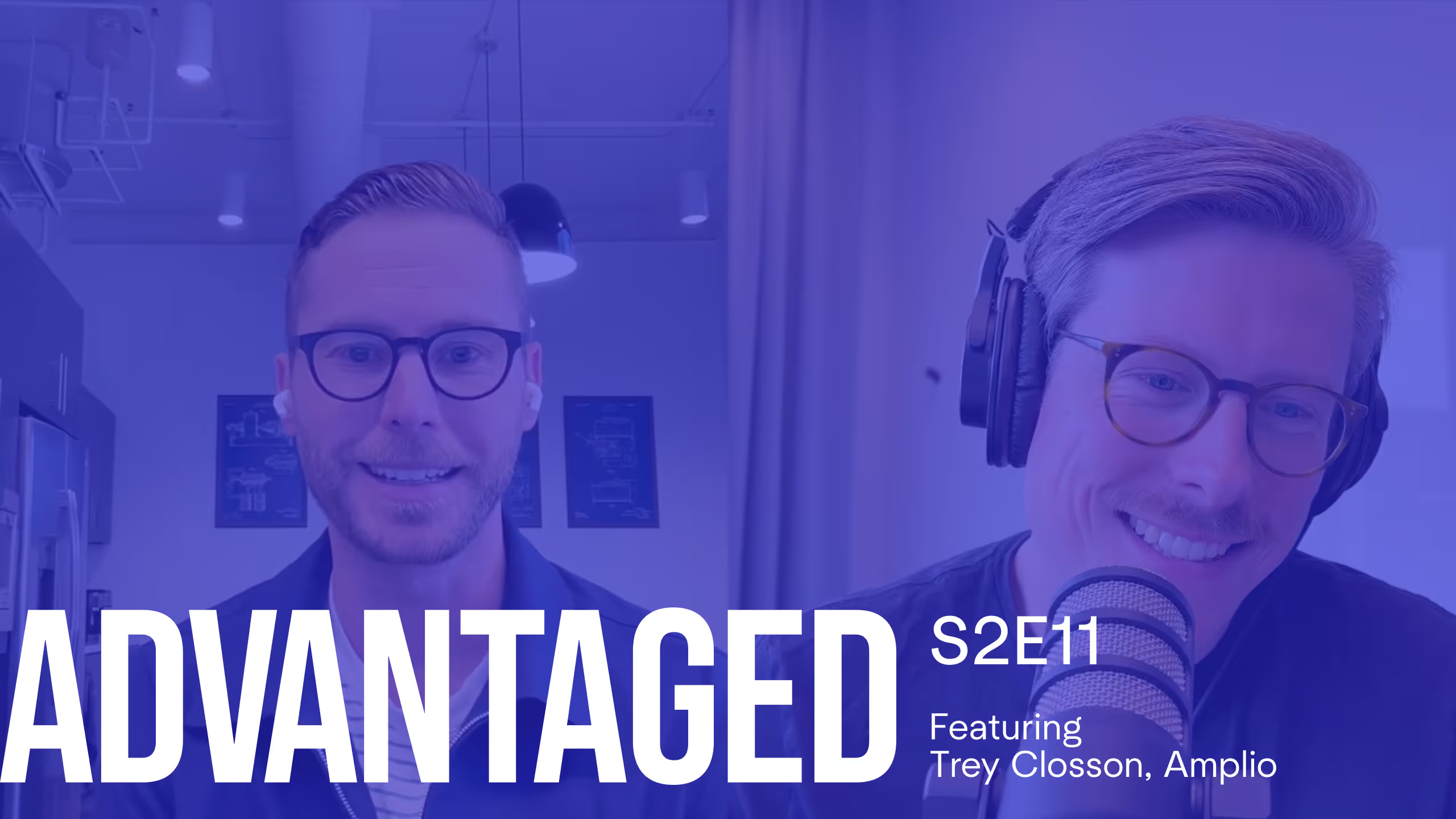
Drew Beechler: Welcome everyone to Advantaged and Alloy Partners podcast. I am Drew Bechler, our VP of Marketing here at Alloy Partners. And your host of Advantaged Alloy Partners is Adventure Builder. We partner with leading organizations and entrepreneurs to co-create. Advantaged startups and venture studios.
Drew Beechler: And here on Advantaged, we often interview corporate innovators, founders, investors, all around venture building, scaling startups, startup corporate partnerships, and the like. We're telling the stories of how corporates and startups win together. And our special guest today is Blake Eth, the partner and the CFO at High Alpha.
Drew Beechler: High Alpha is a leading B2B SaaS VC with over a hundred companies in their portfolio founded in 2015. I often say they're the original Venture Studio, the creator of the Venture Studio model. I actually spent seven years of my career at High Alpha working with Blake and their team.
Drew Beechler: My startup Holder spun out of High Alpha. They're my lead investor, and Allo even originally spun out of High Alpha in 2020 as high alpha innovation before we rebranded earlier this year. I have a lot of love for Blake. I've worked with Blake for over a decade now, which has been a ton of fun for High Alpha as a whole, and I have been really excited about getting to record this episode with their team.
Drew Beechler: So thank you for joining me, Blake. I am really excited to see you doing this.
Blake Koriath: Yeah, thanks, drew. Thrilled to be here and excited to dive in.
Drew Beechler: And so we've been thinking about, what would be the best topic to discuss with the High Alpha team? And it was right around the time that they were working on their annual SaaS benchmarks report, which releases November 11th, just before this episode will go live.
Drew Beechler: I thought that'd be the perfect time just to do a podcast diving deep into all of the insights and data from this year's report hot off the presses, and I thought of no one better than Blake to join me and do this. Let's just start off, Blake, if you could share more around the annual SaaS benchmark report as a whole, how many years this has been running, why it's important to you all to the market et cetera.
Drew Beechler: I think that would be great to just understand the lay of the land from that perspective.
Blake Koriath: Yeah, that sounds great. Drew. So this is the ninth year that the Benchmarks report has been produced and distributed. The first seven years. Our friends at OpenView were the stewards of this report. They created it.
Blake Koriath: And then the last two years, high Alpha has taken over and produced and distributed this report. And OpenView did an amazing job creating a super valuable asset for founders and investors, and we were just really proud and honored to be able to build on their legacy of the last couple years. Prior to hi Alpha producing this report, I would eagerly await it.
Blake Koriath: I couldn't wait for the report to get released. I would dive in, print it off, mark it up, dig through looking for the valuable insights that were gonna help us and our portfolio companies take their performance to the next level. We're just really excited to get this report out into the wild and hopefully folks will find the same level of value that I found with it when it comes out here soon.
Drew Beechler: I got an early access report of it, which was a ton of fun to dig through. I think a lot of us especially those that work in venture or venture adjacent industries, love data and are nerds for a lot of this stuff. But I think it's also just incredibly valuable for the startup founders and operators to think about.
Drew Beechler: Whereas my business, where should we be leaning in and what can we learn from others in the space Walk us through the high level headlines from this year and the trends that really jumped out to you, especially compared to where we were in 2024.
Blake Koriath: Not surprisingly, drew AI was a big focus in this year's report and across two dimensions.
Blake Koriath: First of all, we looked at how AI is incorporated into the product. We asked a specific question to respondents about. How are you incorporating AI into your product with the choices being, it's either a core feature of our product or AI is a supporting feature of our product. We, interestingly, I think we had one person that answered that it was neither that they didn't have plans to adopt AI for their product.
Blake Koriath: But literally everybody else had answered either its core or supporting feature. So that was the product piece of it. And then secondly, the other dimension is AI's impact on company's operations. How are they adopting AI internally? How's it impacting headcount and how important is it to the operations of their business?
Blake Koriath: So those were the two dimensions that we looked at and a couple of things that jumped out to me in the report. We'll get into a lot more of the AI discussion later in those two ways that AI is being adopted by companies. But first of all, from a macro perspective, we'd like to start off the report looking at how are the larger markets seeing ai, what's happening in those and how does that potentially impact a company or an investor?
Blake Koriath: And at the highest level, funding in venture markets is returned to 2021 levels. But once you dive in one layer deeper, it doesn't tell the full story. Deal count remains flat, which means that the average deal size is up significantly, and that is clearly driven by these mega AI rounds, which over the past four quarters have accounted for well over half of VC funding.
Blake Koriath: I was looking this morning and I looked back at the $40 billion open AI round from earlier this year.
Drew Beechler: Yeah,
Blake Koriath: $40 billion is half of an entire quarter's worth of VC funding. So a normal for one deal. Yeah, for one deal. So the last four quarters VC total funding has been about 80 billion a quarter.
Blake Koriath: One deal. OpenAI was half of that in a quarter. So pretty remarkable, pretty crazy time that we're living in. So I thought that was an interesting and important way to just set the stage for the world we're living in right now, which I think everybody knows is an AI world, a post chat GPT world since 2022.
Blake Koriath: But one of the other things that jumped out at me as very little to do, if nothing to do with ai, and that's it. In person is winning in a couple different ways. We asked respondents in one question to identify their most effective go-to-market channels, and the clear leader among 15 choices was events.
Blake Koriath: In the 20 to $50 million a RR band in particular, nearly 80% of respondents identified events as one of their most effective channels. Last year we asked about office culture and. Folks responded whether they were in office hybrid, predominantly remote or fully remote. surprisingly last year, we found that in-office companies were growing faster than remote companies.
Blake Koriath: So we eagerly awaited the results of that same question again this year, and it still held true in-person companies, in-office Companies are still growing faster than those that are predominantly remote. The difference was 42% median growth for in office versus 31% for remote. So being in person, whether you're selling something or just interacting with your coworkers, seems to be a winning approach these days.
Drew Beechler: was that a bigger delta than last year or about the same difference? 'cause I was also curious of was last year still coming out of COVID and you're seeing people just now getting back together for the first time or was that going to become. A trend, broadly.
Blake Koriath: Yeah. The delta in growth rates between an office and remote was relatively similar year over year. There was an increase in percent of companies that were in office or reported being in office this year versus last year. Yeah. A little bit of a trend that we'll see if two years is enough to make a trend, but a little bit of a trend towards more companies being in office.
Drew Beechler: And maybe another point in the causation versus correlation too. 'cause that's, there's always the, do the companies that are well performing just happened to be the ones that are going back to the office? Or is it because they're going back to the office? Why they're performing better too?
Drew Beechler: I think it's probably. But I think the fact that more companies are going back to the office and the trend is remaining is probably, there is at least one point in the causation bucket of that question, which I think is really interesting.
Blake Koriath: Yeah I think that's true. And then maybe just one more little piece of data around in office versus remote that we looked at last year and again this year.
Blake Koriath: Because not saying that in office is the only way to build a successful company. The data shows that those are growing a little bit faster. Those folks that are in office, but from an efficiency standpoint, they're much closer. If you look at efficiency on rule of 40 companies that are in office clearly have more expenses from a rent perspective and some of the costs that go along with that, whereas those that are remote maybe have some cost efficiencies that help offset some of the.
Blake Koriath: The lack of growth, when you're looking at both of those things together, they don't have rent to pay. Maybe they can employ people in more cost advantaged geographies. It's, I think one of the important overarching ideas though, of the benchmarks report is that benchmarks aren't necessarily the be all, end all.
Blake Koriath: You have to look at them in your specific context, in your company and your strategy, and make sure that those fit in well with what you're trying to accomplish as a business.
Drew Beechler: Totally agree. Let's double click into more of the AI transformation, the AI topics. One of the most striking findings to me was that 36% of companies now say the AI is core to their product and we're really seeing this bifurcation here.
Drew Beechler: And you talked about what the funding difference is, but talk more about the difference between these companies that were founded in the last few years. Versus those that were started a decade ago and more importantly what does that split mean between growth rates across revenue bands? And I think there's a very particular 2022 really is that date where you can tell of when did generative ai, at least with chat GBT launch, become mainstream.
Drew Beechler: And that's where you see this bifurcation between the companies founded after that. The democratization of AI and before, but I'm curious how have you been thinking about that and what are some of the other kind of data points in there that were interesting to you?
Blake Koriath: Yeah it's really not surprising that a greater percentage of companies are incorporating AI more deeply into their products, but it was eyeopening to see how that's evolved over the last 10 years. So we asked this year about founding year of the companies, the respondents to the survey, and we looked at.
Blake Koriath: The percentage of companies where AI's core to the product versus those where it's just a supporting feature by founding year. And when you look at the last 10 years, literally 0% of the respondents from 2016 whose companies were founded in 2016 said that AI was core to their product and. Every year, that percentage over the last 10 years increases up until 2025, where literally 100% of respondents said that AI was core to their product in 2025.
Blake Koriath: And it really crossed the big 75% or so threshold in 2022 for companies that were founded that year. And it's hard to believe as we sit here today, drew, we're three years post. The public release of chat GPT, it doesn't seem like that long ago, but a lot sure has changed and companies have just really embraced building AI into the core of their product because of how important that is for their future.
Blake Koriath: And you asked about growth rates too, and this was surprising, but maybe shouldn't be. When we compared the growth rates across all the different a RR bands. So we. Break respondents up into less than a million in a RR one to five, five to 2020 to 50, and greater than 50 million a RR because obviously those businesses are at different phases and different stages, so it's important to understand how those in the same bucket perform against one another.
Blake Koriath: But we broke that up into those bands at every single a RR band companies where AI was core to the product. We're growing faster than companies where AI was simply a supporting feature. Yeah, so that was really eye-opening and something that we were excited to see that the data was supporting those companies that are building AI in it core we're growing faster than those that we're not.
Drew Beechler: The other thing that I thought was also very interesting or interesting to me at least, is growth rates, particularly between the smaller companies. The top quartile are growing significantly while other, all other segments were decreasing over the last handful of years.
Drew Beechler: I was curious, kind of your thoughts on why I think I have my own around. It's much, especially in an AI first world, it's much easier to get initial revenue and maybe much harder to get the renewals and we're seeing. I feel like there's a new company every quarter that's hit a new record, a RR 10 million in X amount of days, whether it's Lovable or Sierra or whoever.
Drew Beechler: That has some new record for the fastest benchmark to a certain a RR. Why are we seeing this more now? And I think your data is showing that it's not just something we're feeling, but it is something that's appearing in the data as well.
Blake Koriath: These earlier stage companies are growing super fast and I think that.
Blake Koriath: It's connected to what we were just talking about a few minutes ago. Companies that are just getting started 100% of them are making AI a core part of their product. And every company out there, at least every company that I am aware of, has a mandate to at least experiment with ai. And that's a big tailwind for all of these new companies that are out there.
Blake Koriath: If you can find the right person within a larger. Enterprise and you have what at least sounds like a compelling solution, then there's a pretty decent chance that they're gonna try it out and experiment with it. But as you mentioned, the real point where the rubber meets the road on this is that renewal time and see whether or not the growth is sustainable.
Blake Koriath: And before we dive into that maybe a little bit further, you also mentioned some of these companies that are growing just at rates that we have never seen before. It is remarkable. What I have to remind myself is that's a very small percentage of the overall companies that are out there.
Blake Koriath: So even though those are the stories you hear, the relative percentage of companies that are growing at those unbelievable rates are still very small. So I think it's hard to really measure yourself against that. Certainly if you can be in that stratosphere, then that's a great thing, and the value and valuations of your business is gonna increase like crazy.
Blake Koriath: But there are gonna be many good businesses built in this AI world that don't grow at those rates. They build, they find value with their customers. And and then, overnight success story, 10 years later, they're a big successful company.
Drew Beechler: In preparing for this discussion, you mentioned a podcast and I actually listened to it over the weekend, the 20 Minute VC podcast round table with Harry and Jason Lempkin and Rory or Driscoll.
Drew Beechler: And it was amazing. You're right, it was a, it was an incredible podcast episode, but specifically they talk about this too, that we are in a moment in time where everyone is a buyer. Everyone is out there buying. We're usually in the software market. There's only a very small percentage. So yes, your tam may be whatever, many billions, but there's only, 5%, 10% in any given year within that tam that are even in a.
Drew Beechler: Buying cycle, if you will. And we're in a very unique moment in time, and this is all, I'm just more or less regurgitating their opinions. But I also agree that we are in a very unique moment in time where we do feel like a lot of it is winner take all where everyone is in a buyer's market right now because they're all actively have a mandate to go and try all of the latest AI software.
Drew Beechler: And so I think that is also part of this too, where. Thinking about the companies that are just building slower, but just great fundamental businesses versus there's the other end of the spectrum where winner take all and we're going after all of it. And you're seeing the monster rounds at A record high, multiple on the, on their revenue. And I think that is also just an interesting way to, to think about some of those as well in what is the buying lifecycle? And that will probably not, it will not be like that forever. Who knows how long we will have. This kind of market, particularly within that technology sector and particularly within AI tools.
Drew Beechler: But I think it's just something worth noting and I'll include a link to that podcast 'cause it was just a great discussion around that. But I'm curious if that's also what we're seeing and why we're seeing some of that and that disparity almost between those kind of classes of companies.
Blake Koriath: I think you raised a really good point, drew. So I think you could maybe separate the world of software companies in AI age into two categories. You're either building in a brand new, totally greenfield market, like a vibe coating product, for instance, that is a land grab and a hundred percent of buyers are in a buying cycle right now versus say an HRIS platform.
Blake Koriath: Pretty much every company already has an HRIS platform. There will be a new AI driven HRIS platform that either is already being built or will be built that will have a slower run, probably in replacing those existing tools out there, but has a very large market opportunity nonetheless, and could become one of those big successful companies, just probably not at the same speed as.
Blake Koriath: The vibe coding platforms because of the nature of the market that they're selling into.
Drew Beechler: It's so important. a follow up question to some of this, what are you seeing, whether it's in your own portfolio companies or in the companies that you're evaluating as to what's leading to great retention or not?
Drew Beechler: As we said, that is where the rubber is gonna hit the road. With a lot of these companies where are we seeing the standouts from a retention perspective?
Blake Koriath: Yeah, I'm glad you asked that, drew, because some things never change.
Blake Koriath: If you build a product that delivers real value to your customers that once they've used it, they can't see themselves living without, then you're gonna have great retention. that's a tale as old as time with software companies. nothing really changes in the AI world. You can't just build a product incorporating AI for AI's sake.
Blake Koriath: You have to have real true value that you're creating for your customer. So I think that you don't need to overthink how to drive great retention among your customer set. You just need to create a valuable product. And make sure that your customers are getting that value quickly and it's delivering a real ROI for 'em.
Drew Beechler: It's just the standard blocking and tackling of software businesses and retention. Yeah,
Blake Koriath: absolutely.
Drew Beechler: Let's dig a little more into impact on unit economics as well. You all handful of data points around headcount and where headcount is going and. unit economics as well, on margin.
Drew Beechler: let's talk maybe about what AI is doing to the operating model itself within SaaS businesses. You're seeing notable headcount reductions, especially I'd say among what you're calling scaled companies, these doing 50 million plus and a RR. Walk me through what we're seeing happening here is this efficiency games from AI tooling, or even something more fundamental just about how companies today are being.
Drew Beechler: Built and how companies are scaling going forward.
Blake Koriath: yeah, just to put some real numbers with it, drew, for companies that are greater than 50 million in a RR, the median number of employees from 2022. So just three years ago was nearly 900 and among our respondents this year it was somewhere just shy of 400.
Blake Koriath: Wow. So a 59% decrease in the last three years in median number of employees for companies at that level. You look one level down to 20 to 50 million in a RR, and it was about 225 employees in 2022, and in 2025, that was down to less than 150. So down 42%. So what you're saying we're seeing in the data, it's true.
Blake Koriath: Why is it happening? I think it's a combination of two things. First of all, I think that it's been more difficult to raise capital in the past few years. So 2021, the capital markets were open. The Zer era was. Was a thing. Rates were low. Venture capital you could walk into any venture fund and give yourself a pretty decent chance at raising some funding that allowed companies to operate with just less financial rigor and discipline.
Blake Koriath: They hired aggressively, they had to support growth because the market rewarded growth at that time. Higher burn, not an issue. No problem. We'll just go out and raise more capital. Since then, capital availability has. Been diminished, especially as we talked about earlier, those companies that are more scaled and the discussion earlier as well on VC activity.
Blake Koriath: This new funding is supporting the AI companies not nearly as much the. Pre AI companies that are trying to make that transition. So I think that's the primary reason. I think the secondary reason, and maybe a little bit of an overstated reason, is the efficiencies that they're seeing from an AI perspective.
Blake Koriath: It's definitely having an impact, but I, it's hard for me to believe that would solely be able to drive a more than 50% reduction in headcount among those $50 million companies.
Drew Beechler: it's more in the operationalizing the efficiency of these businesses and doing what you need to do in order to make the business profitable or make the business a viable, business model.
Blake Koriath: Yeah. I think companies were incentivized to not have to be that efficient. A few years ago, and then those incentives went away and companies adapted to it. They figured out how to do more with less, and then it just happened to have coincided with this AI wave that is also adding a little bit more efficiency to their operations.
Blake Koriath: Yeah, and we did dig into that a little bit as well in the survey and how AI was impacting how companies were operating. Over 50% of companies across every A RR band said that AI had caused reduced headcount. For their companies, they were hiring less or they had hired less or eliminated roles due to ai.
Blake Koriath: So don't get me wrong, it is having a real effect for sure. And then interestingly, the most impacted departments within those companies are engineering departments. So one of the first places to really see a lot of heat and a lot of technology around AI and efficiency with all these coding platforms.
Blake Koriath: And it, it is driving some real reductions in the, in that area in particular.
Drew Beechler: we're seeing it within public companies as well. You had a couple of slides around revenue per employee, a RR per employee, and that growing significantly, which makes sense obviously if headcount is decreasing, but particularly you looked at even like publicly traded companies and software companies.
Drew Beechler: And I thought that was a very fascinating, Dave, if you wanna share some of those data points too, even.
Blake Koriath: Yeah, we love to look at data from Metech. They have a really comprehensive data set around public SaaS companies, and so we looked at a RR per employee for public SaaS companies, and the median among all public SaaS companies that metech tracks was $393,000, which was up, I think about 10% from last year.
Blake Koriath: But these numbers have just continued to climb and the top 20 companies on that list. Every single one of them generates more than $580,000 in a RR per employee. So pretty remarkable efficiency for those public SaaS companies.
Drew Beechler: Yeah, and it'll be really interesting to see how this continues to grow into the next couple of years as well.
Drew Beechler: Something specifically within benchmarks that I always think is really interesting. Looking at data like this is what does world class look like in 2026?
Drew Beechler: And I am also very interested in how is this changing as you're talking to startups and portfolio companies and founders, it's always helpful to think about what metrics are more important now than they were a handful of years ago, and what's may become less important. So I'm curious, what have you all been seeing in this year's report as well as to the best companies in the world?
Drew Beechler: Where are they performing better or. Or not as well and what's become more important or less important than it was over the last handful of years. And we've talked, I know a little bit about some of these a RR per employee, but where are some of the other areas too that may be surprising even
Blake Koriath: Yeah.
Blake Koriath: So I think what we were just talking about, a RR per employee, super important. It is a very comprehensive measure of the efficiency of your business. Are you able to sell service? And d deliver product to your customers in a scalable way. So that one to me is always one of the most important metrics.
Blake Koriath: The fact that companies are able to do more with less I think has become a really important trend that has borne out in the data of the last couple years. Retention wise, NRR net revenue retention has been super important. And as I think we alluded to earlier, mentioned earlier. That NRR is the engine that makes SaaS businesses go and grow.
Blake Koriath: If you can grow your business on your existing customer base without even selling any new products to new customers, that's pretty magical. And so that's always been very important. But there has been more momentum, I'd say lately around gross revenue retention because if you can't retain your customers, then how are you gonna sell more to 'em?
Blake Koriath: So I think GRR gross revenue retention has become a more important signal for investors, for acquirers I think GRR has become a really important signal of product market fit.
Blake Koriath: On the opposite end of the spectrum, one of the metrics that I think is becoming a little less important is gross margin.
Blake Koriath: Still important. But less important in age of ai. So we saw a decline in gross margins that are compressing due to the cost for building many AI products into companies, products and offerings for their customers. But the growth that those companies are experiencing because of AI is far outweighing the margin compression.
Blake Koriath: So certainly some, something to be mindful of as a company scales, and there are certainly extremes to where negative gross margins or where it's just not gonna be possible to generate a positive gross margin based on the way you're pricing and selling the product. That's not a good thing, but companies with slightly lower gross margins don't seem overly concerning to me.
Blake Koriath: Given the cost to build AI into your product,
Drew Beechler: do you think. As software and SaaS matures, that's just a natural byproduct of the industry maturing that gross margins are naturally eaten out. Your margin is my opportunity kind of mentality, or do you think that there's just a period of time we're in now, where it's an early, like heavily adoption period of a new technology?
Drew Beechler: I'm curious.
Blake Koriath: Yeah, that's a really good question and not. One I think I know the answer for yet. I think it's clearly because of the $40 billion open AI round, it's very expensive to, to build these products that are being integrated into these other companies products. But also by the same token, they are.
Blake Koriath: Being subsidized by vc, so you're not even experiencing the full cost of building chat GPT into your product, and it's already causing some margin decreases. So I don't know what it's gonna look like over the long term. I think likely that maybe it's a little bit lower. When we get to a steady state in terms of gross margins, then they were historically, but there are a lot of other things we've talked about that are positively impacting these companies, allowing 'em to do more with less, generate more a RR per employee that helps more than offset those decreased gross margins.
Blake Koriath: But we'll see how it all plays out. It'll be interesting to see in future years of the survey.
Drew Beechler: Yeah, I agree. I think it'll be really interesting.
Drew Beechler: I'll wrap us up here with I think a very big open debate and question. Particularly among, I think investors in the market's a fun one that people go back and forth on, but you have some people saying that AI is going to completely disrupt software. Every enterprise and company is just gonna use AI to vibe, code their own software, and they're never gonna buy, Salesforce CRM again.
Drew Beechler: While others are saying this is, dramatically overblown based on what you're seeing in the data and across, your portfolio and this unique. Lens you have with the companies you all work with. What is your kind of bull and bear case for how you're thinking AI reshaped software over the next handful of years really here?
Blake Koriath: Yeah. This has been the hot topic in software, in SaaS just like we've been talking about earlier, it's gonna be interesting to see how it all ends up playing out. My perspective is that the idea of AI and SaaS are two. Related, but separate things. AI is an enabling technology. SaaS is a business model and a delivery model, and those things can coexist and you think about how chat GPT works, it is software delivered over the internet via a browser or via app or whatever the case may be, and I pay for it.
Blake Koriath: Monthly.
Drew Beechler: And a
Blake Koriath: subscription. Yeah, and a subscription. So those two things are in harmony right now. And your comment about people just vibe code their own products and you don't need Salesforce anymore, for instance. I think we are have a long way off from that. I may be wrong.
Blake Koriath: We'll see. But I think we're a long way off from that. And so I think in the near medium term and maybe even the longer term. We're not gonna be at that point. Now you asked about the bull case, the bear case. I'd like to start with the Bear case. The Bear case is that there are massive enterprises out there with extraordinarily complex operations systems.
Blake Koriath: You think about legacy ERPs and how. Embedded into a business's operations and how important they are financially for that company, if they're a public company, being able to report accurately, make sure that they have all the right controls in place. Those even I think a few years from now are gonna be extraordinarily difficult to rip out, replace with something different.
Blake Koriath: So I think that the bear cases that we're further away from complete. Tech stack replacement at many companies than folks may the market may lead you to believe. There are also even smaller companies, a lot of legacy manufacturing businesses, kind of old school businesses that are gonna be just slow to adopt technology because of who's running them or because of their risk aversion for what that might do to what they, the business that they know, how you know how to operate.
Blake Koriath: We'll see, that's my bear case. The bull cases that I'm totally wrong and that ag agentic AI is just gonna take over the world, and all you need to do is just tell the AI that you want to replace your ERP and ask it to do that for you. I still do think we're a ways off from that, but it sure is gonna be interesting to see how that all plays out.
Blake Koriath: But I'm curious, drew, what do you think? What's your bull case and your bear case?
Drew Beechler: Yeah, I think we are conflating. The two, oftentimes, Chet, GBT is just, one of the greatest SaaS companies of all time in the moment. I think we're still just Not fully penetrated with cloud software and there's still many companies that are using on-prem. I love that Oracle is making a resurgence, which I think is wild right now. So I think that there's just a lot of these industries that they are gonna be slow to adoption, If anything, it will just create more and more opportunity for software companies. I think many more entrepreneurs to build smaller companies that can be very niche and focused, and I think that will create a lot of opportunity. I think the proliferation of SaaS will just continue, but I do think it'll make, the creative human element behind software. I think ui ux is gonna become even more and more important. I think brand and the process power too that these big companies have is gonna be, become more and more important as well. That's where I think the winners are going to emerge, I do think that SaaS is not going anywhere or dying. I do think that there is a world back to the margins question, where software margins broadly decrease a little bit and are not at the like 80, 90% range where we've seen in the past and they may. Level off closer to traditional service-based companies even, which I think could be really, interesting to see kind of impacts within the market and in the venture and investment ecosystem, the private markets as well.
Drew Beechler: But I think that for the time being they're not going anywhere. there's just so many new opportunities too, it is just, there's other application layers for software as well. there's no lacking for opportunities for software to be built in the future. And that's what I'm most excited about is just all of the areas where. We can't even imagine we're still in the horse and buggy, era That if you ask people, what they would've wanted. Is it a faster horse, not a car? Thing. And I think that's definitely where we're at right now. We can't even really comprehend what is an AI first world really gonna be like. the only other point I'll make is.
Drew Beechler: How quickly this technology wave has been adopted, particularly within the enterprise. We've never seen it grow. I feel like that fast before, software never proliferated that fast. Even mobile, like the internet itself it's just, it is wild that 2022, within three years, we are seeing trillions of dollars, in data center commitments over the next, decade and it that kind of, the level from the enterprise adoption, acceleration is wild to me. And I think that kind of just means we really have no idea what the next five years really truly could hold, which I think is an exciting time to be building startups and be investing in early stage companies for sure.
Blake Koriath: Yeah, I totally agree. And many folks are saying that now is as an investor.
Blake Koriath: It's a once in a generation or once in a lifetime opportunity to invest in these companies that are reshaping how the world works and. We're excited to be in that in that space and looking at these companies that are rethinking and reshaping how you and I do our jobs and how many millions of people will do their jobs in the future and how we experience the world.
Blake Koriath: I appreciate you letting me turn the mic around on you, drew and put you on the spot with a question there.
Drew Beechler: these are the things I think about all the time. this is a ton of fun. I love getting to nerd out on data a, but always just fun to, to spend time with you.
Drew Beechler: Blake. One thing I should have noted earlier as well, so the SaaS benchmarks report is now live when this will, and this will go live. You can download the report and see all of the high level overview and get the full copy at high alpha.com/saas-benchmarks, s aas s dash benchmarks. thank you so much Blake for joining me.
Drew Beechler: Make sure everyone goes and downloads the report. Sign up to take the survey next year as well. I'm excited to see you all carry on this torch and keep it going for next year will be the 10th year, so hopefully we have something. In store for the 10th year.
Blake Koriath: Yeah, you're really putting the pressure on Drew.
Blake Koriath: But we'll be up for the challenge and. Thanks for having me. This was a ton of fun. I love talking about this stuff. And thanks to all the people who filled out the survey. it wouldn't be possible obviously without those folks who took some time out of their day to fill out the survey. And it's super valuable, hopefully for them being able to digest the data when we put out the report and hope to have even more people respond next year with the richest data set ever.
Blake Koriath: We're thrilled to get this out into the world and hope people find it extraordinarily valuable and we'll look forward to hearing feedback on the report and doing it again next year.







































.avif)