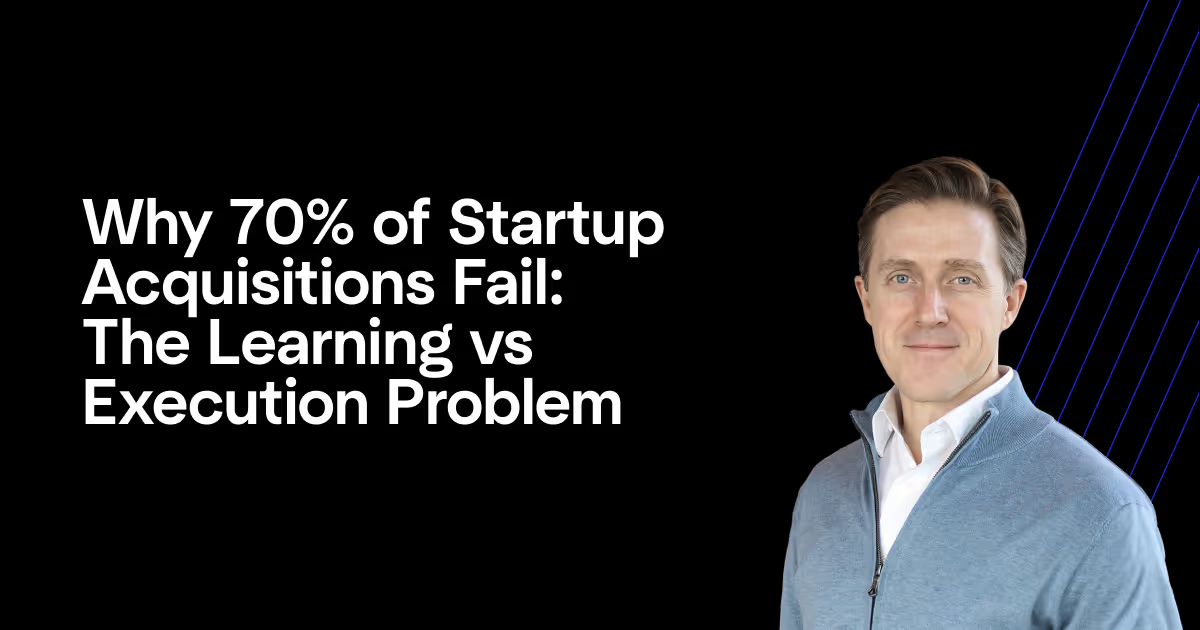
Here's a puzzle: Large companies acquire startups at a 70-90% failure rate, yet the same research shows that "bolt-on" acquisitions—buying companies in the same industry doing similar work—succeed 80-85% of the time.
What's the difference?
The answer lies in understanding two fundamentally different types of problems that organizations solve.
Learning problems require speed, experimentation, and tolerance for ambiguity. You're figuring out what customers actually want, which features matter, how to reach users, what the business model should be. Success means pivoting quickly based on new information. Failure is cheap and frequent. Decisions happen intuitively, often with incomplete data.
Execution problems require efficiency, predictability, and scale. You know what works—now you need to do it 10,000 times without errors. Success means hitting targets, defending margins, and optimizing processes. Decisions require data, planning cycles, and cross-functional alignment.
Startups are purpose-built for learning problems. Their small size, limited resources, and desperate need to survive make them incredibly good at rapid iteration and discovery.
Large companies are purpose-built for execution problems. Their processes, approval hierarchies, planning cycles, and capital allocation systems make them incredibly good at doing known things at scale.
Here's where acquisitions go wrong:
Large acquirers often assume that a startup with some traction is ready (or can be made ready) for execution mode. They acquire the company and immediately apply their execution machinery: quarterly planning, ROI thresholds, integration with existing systems, standardized processes.
But many startups are still solving learning problems. They've found some product-market fit, but they're still figuring out critical questions about their business. The moment you force an execution mindset onto a company still in learning mode, you kill what made it valuable.
The startup can't pivot quickly anymore—too many stakeholders. It can't experiment cheaply—every test needs a business case. It can't make intuitive decisions—everything needs data and alignment. The very things that made it successful become impossible.
Meanwhile, bolt-on acquisitions succeed because they're buying companies that have are operating in a known space with execution problems the large acquirer understands. These companies are ready to scale. The acquirer's execution machinery is exactly what they need.
The critical question for any acquisition:
Has this company transitioned from learning mode to execution mode? Are they still discovering their business, or are they ready to scale what they've proven?
If they're still learning, you have exactly two viable options:
- Grant them complete autonomy (which most acquirers psychologically can't do after paying a premium)
- Don't acquire them yet
The implication is uncomfortable: Most transformational acquisitions fail not because of poor due diligence or bad integration planning, but because you're trying to impose execution solutions on learning problems.
You're asking: "How do we efficiently scale this?" when the startup is often still asking: "Is this what we should be building?"
Different problems. Different solutions. Disastrous mismatch.
What's your take? Have you seen startups succeed or fail post-acquisition based on this learning/execution mismatch?



































































.avif)