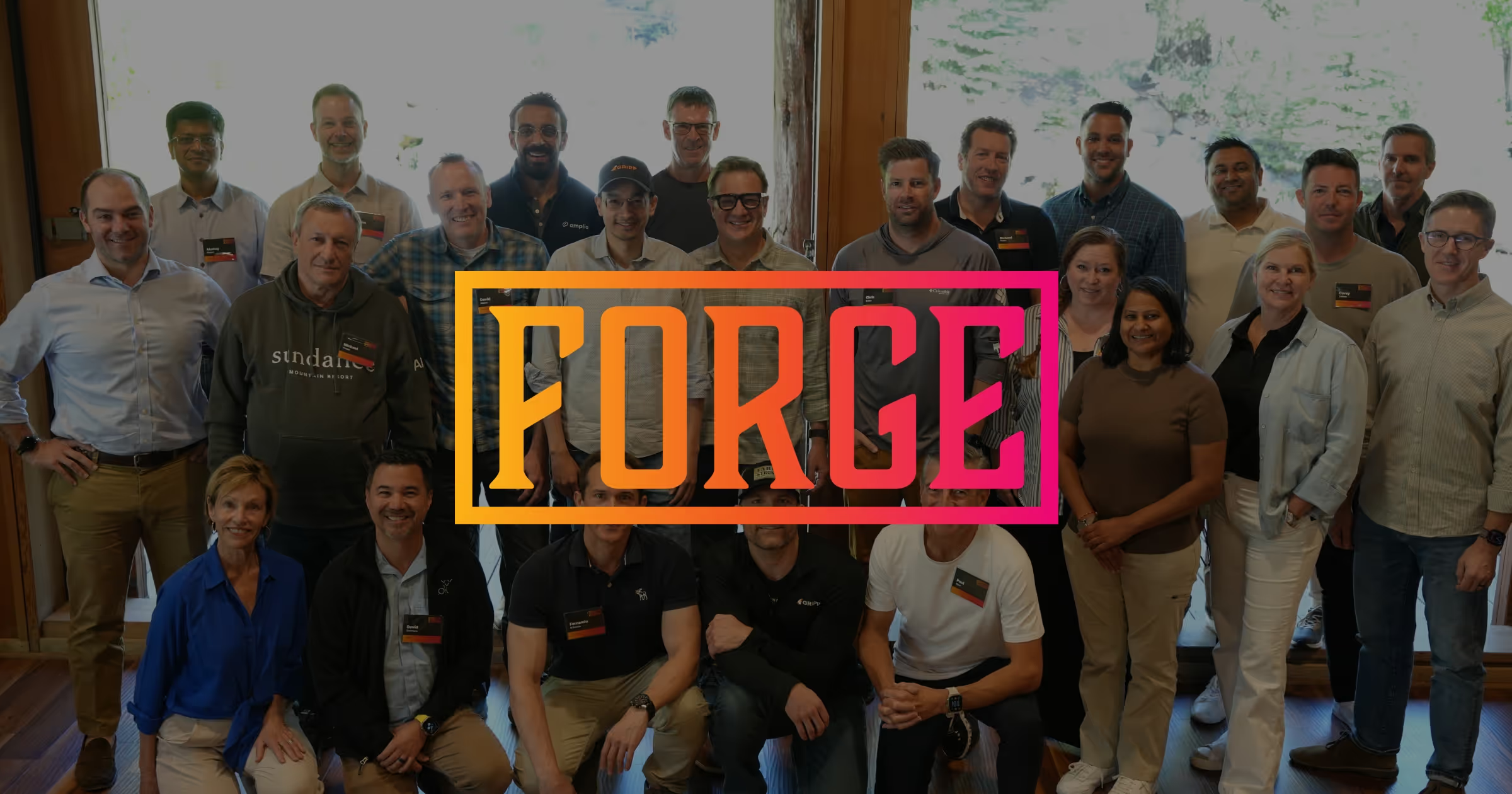
Last week, I spent two days in Miami at the CVC + Open Innovation Summit alongside 80 corporate venture leaders. The theme: "From Capital to Impact — The 2026 Playbook for Corporate Innovation, AI, and Systemic Growth." A few takeaways that stuck out to me from two days of closed-door, candid conversation.
Physical AI Is Having a Moment — and Industrial Companies Are Paying Attention
The humanoid robotics boom at CES wasn't just a tech spectacle. For industrial companies that spent the last two years focused on AI-driven employee productivity, it was a signal: physical AI is now a real strategic consideration. The groundwork is there — Industry 4.0 connected the machines, and years of IoT investment finally has ERP, PLC, and PLM data flowing to the same lake. But as one CIO put it, "The reason God got to rest on the 7th day was because He didn't have to deal with legacy systems." The infrastructure is closer than ever; integration is still the hard part.
Industrial Leaders Are Getting Pragmatic — Not Utopian — About B2B AI
There's a quieter, more useful conversation happening among industrial manufacturers than what you see in most AI coverage. The focus is on "dirty, dangerous, and dull" work — the jobs where autonomous systems create real safety and efficiency gains, not just headline demos. And interestingly, the group largely believes the future of robotics is autonomous-to-autonomous interfaces, which actually makes the race toward "emotive" robots a distraction. The near-term question isn't what robots can feel. It's how humans best oversee autonomous counterparts during the transition. That's a governance and operations problem as much as a technology one.
CVC Is Being Held to a Higher Standard
After the 2022 Recession, the financial reality for CVC teams is still being redefined: returns must clear the risk-adjusted cost of capital and, for some teams, even reach VC-level performance (otherwise, as one leader put it bluntly, "you're just glorified business development"). Strategic metrics are evolving as well: teams are considering EBITDA lift, net-revenue contribution, and time-to-liquidity/-acquisition.
The clearest path to hitting those numbers? Driving proof-of-concepts. CVC leaders who are generating strategic impact are getting deep into KPI definition, utilizing short-term POC budgets to accelerate implementation, measuring ROI, and driving business adoption. That's a co-development orientation, not a passive investment one.
What We're Building at Alloy
This is exactly the orientation we work with: at Alloy Partners we co-create "advantaged" startups with corporations — especially industrials, who are often overlooked by venture-backed startups. We're currently assembling a consortium interested in co-designing a portfolio of AI-native startups focused on addressing industry growth priorities. Topics of interest include:
- Autonomous, Integrated Supply Chains
- Sustainable & Decarbonized Industry
- Industrial AI Data Foundation
- Sales Enablement & Revenue Mgmt
- Engineering Drawing Management
- Quality & Compliance Intelligence
- Trade Finance & Insurance
The goal is a pipeline of strategically relevant ventures that unlock new growth for corporate partners while targeting VC-like returns.
Corporations can either co-create the future with AI or be disrupted by it. If you're a CVC or innovation leader thinking about how to move from capital to impact, we invite you to join us in building the future of the industrial sector. Let's talk.









































.avif)