You win in business by being contrarian and by being right, and “going with the flow” is a fast track to failure.
Between oscillating tariff talks, AI’s potential for massive disruption across industries, and emerging cross-border data regulations, markets are in commotion. The lack of clarity makes it hard for many business leaders to make confident decisions, but it’s especially challenging for big organizations. Because of their size and structure, these larger companies are cautious by design.
But being careful will only get you so far. It’s these moments of uncertainty when winners are decided. Winners use uncertain times to take chances, run experiments, and, in short, act as opposed to sitting on their hands and waiting to see what’s going to happen next. You win in business by being contrarian and by being right, and “going with the flow” is a fast track to failure.
From Disruption Comes Opportunity
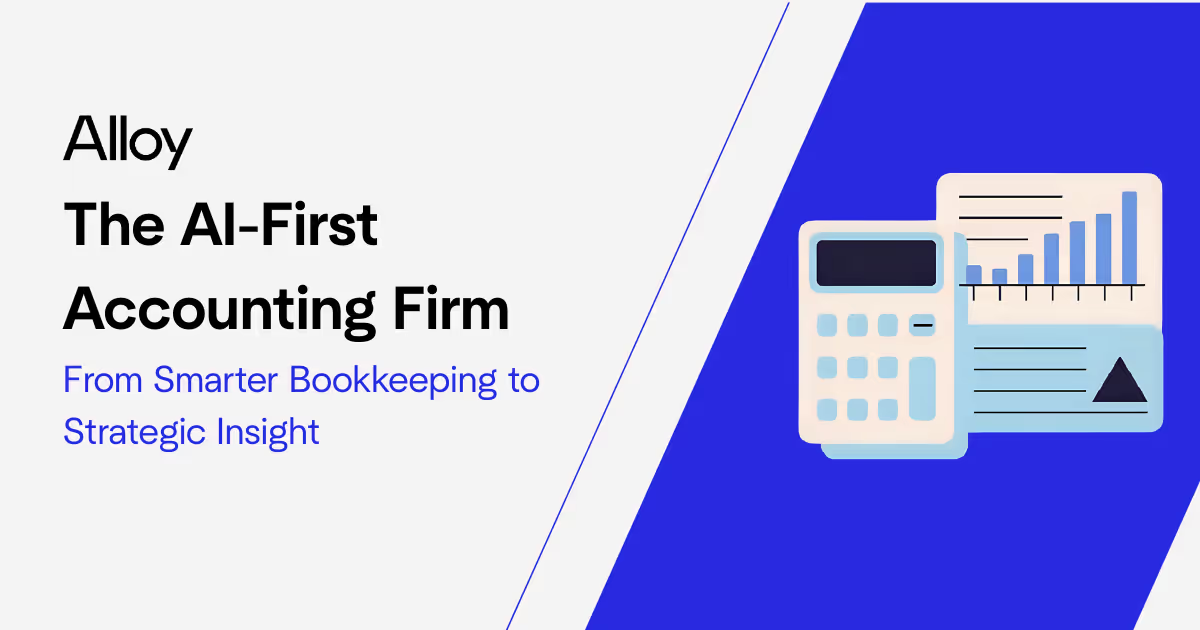
The accounting industry is one example of an environment in which many players, including the big ones, are in “wait and see” mode. But that’s a mistake. Because so much of accounting is rules-based, data-driven work, it is a perfect use case for emerging AI technologies. This is especially true because there just aren’t enough people graduating from college to enter this field to keep up with demand. AI can help bridge the gaps left by this talent shortage.
However, indecision and uncertainty are plaguing some organizations that have yet to make a move on AI. Many firms want to capitalize on AI, but are stuck in discussion loops about how and when they can implement these tools. Planning sometimes extends over months without any meaningful progress. Amid the uncertainty , many accounting firms have thrown their lot in with private equity firms, selling shares to investors as a way to bring in new cash and help to prepare for whatever might come next.
Private equity looks for returns first through efficiency. I wouldn’t bet against them and their ability to squeeze efficiency out of the accounting industry, including through use of new technology. But it’s hard to imagine the future winners in the space will be the firms focused on efficiency gains. The accounting industry is ripe for disruption, and those who are willing to take a chance have a lot to gain. Because of technology-driven shifts, market share in the accounting industry will be up for grabs over the next several years, and only those new entrants and incumbents who are actually pursuing growth bets—not just efficiency plays—will be in a position to get a piece of the reconfigured pie.
Will PE buyers let their accounting industry assets experiment for growth in capital inefficient ways? Time will tell. What we know is that the firms that do not take decisive action now are going to be left behind.
Reimagining AI
Most big company applications of AI technology are focused on efficiency gains, but that barely scratches the surface of what this powerful technology is capable of.
There are three main ways companies can use AI: improve efficiency (reduce expenses), enhance the customer experience, and create entirely new business models. It’s that last category that is the most exciting, because it’s about creating the kind of new businesses enabled by AI that we couldn’t have dreamed of before.
The problem is that we’re still in the nascent stage of AI use and it’s hard to imagine entirely new business models—especially when you’re working to preserve an existing, reliable business model!
Think about it like this: over 100 years ago, when movies were first being made, they looked like stage plays. There was one camera. People came into the scene and acted in front of the camera as though they were in front of an audience because that is what people were used to. It took a while before mainstream moviemakers realized there were new and different ways to use the camera to tell stories. It took decades for movies to develop new technologies because so many couldn’t think outside of how it had been done in the past.
The same thing is happening with AI right now. People are considering how to apply AI to what has already been done, and the result is often just that you can do it a little bit cheaper or a little faster with AI. What organizations need to be doing is figuring out how to use AI to unlock whole new areas of growth, and large organizations are lagging in this effort.
Plenty of new business models are being invented right now, but the work is being done by agile startups, not large corporations. We have many such startups in our portfolio. To develop new business models, large corporations need to be running far more experiments. They need to run fast, cheap, and “weird” experiments that challenge status quo beliefs about the way things are done. Venture building is a fantastic engine for such experimentation, as long as the governance and incentives are properly designed.
Waiting to see where things are going is a doomed strategy. Whether you’re figuring out how to inject AI into your accounting workflows or dreaming up totally new business models, the only way to succeed is by doing. There is no data about the future. The only way to get data about the future is to create it. Action creates data.



























































.avif)