Most business model innovation dies in a conference room.
A Fortune 500 gets the mandate. Serve a new customer. Adopt a new technology. Earn money a new way. A team forms, a consultancy is hired, and the work begins: map the current model, sketch the new one, run the workshop, build the roadmap. Twelve weeks later there is a 40-slide deck and a pilot. The deck gets praised. The pilot gets a small budget and a part-time team. Eighteen months on, it quietly closes, and everyone agrees the timing wasn't right.
The idea was usually fine. The framework was usually fine. What failed was the assumption underneath all of it: that a new business model is something you can think your way into from inside the company that needs it.
Business model innovation is a verb. It is what happens when you build a real venture, with a real customer, real revenue, and a real founder with something to lose. You don't innovate a business model on a whiteboard. You build one in the market and let reality tell you which version actually works.
What does business model innovation actually mean?
Business model innovation is the practice of changing how a company creates, delivers, and captures value, not just what it sells. It reaches past product and pricing to rework the customer a business serves, the way it earns money, and the resources and processes that make the model run.
Most corporations rarely pull off a genuinely new business model internally, because their customers, their economics, and their incentives are all calibrated to the model they already run, which is exactly why co-creating a separate venture, built for the new model from day one, so often succeeds where an internal workshop fails.
The clearest map of those parts is still the one Mark Johnson, Clayton Christensen, and Henning Kagermann published in Harvard Business Review in 2008. Their four-box model breaks any business into four linked pieces:
- Customer value proposition. The job the offering does for a specific customer.
- Profit formula. How the business makes money: revenue, cost structure, and margin.
- Key resources. The people, technology, and assets that deliver the value.
- Key processes. The repeatable ways the business operates and scales.
The framework is good. It has held up for more than 15 years because it is right. The problem was never the four boxes. The problem is what we did with them. We turned a diagnostic tool into a strategy exercise, and a strategy exercise produces a strategy document. It does not produce a company.
Why do corporations fail at business model innovation?
Walk into most corporate business model innovation efforts and you find the same three traps. Each one is a place where the company's own strengths quietly work against it.
The trapWhy the internal build stallsWhat it costsA new customer segmentEvery instinct is tuned to the existing customerThe new segment gets served like the old one, and rejects itA new technologyThe organization's DNA was built for the previous technology generationThe build inherits old constraints and old talentA new business modelCap structure, incentives, and talent all assume the current modelThe new model is judged by the old model's math, and loses
The new-segment trap. A company that has spent decades serving enterprise buyers decides to serve small businesses, or consumers, or farmers. The product team knows the old customer cold. That knowledge is the asset, and it is also the trap. Pricing, support, onboarding, and sales motion all get designed for the customer the company already understands. The new segment gets a slightly reskinned version of the old offering and walks away.
The new-technology trap. A company built on one technology generation tries to build on the next. The talent, the architecture, and the vendor relationships are all calibrated to what worked before. The new build starts carrying that weight on day one. It is staffed by people who are excellent at the old thing and learning the new one, governed by processes written for the old thing, and measured against benchmarks set by the old thing.
The new-model trap. This is the deepest one. A company whose entire machine is built to sell products decides to run a marketplace, or a subscription, or a platform. But the cap structure, the incentive plans, the planning cycle, and the talent were all designed around the existing profit formula. A new model has different economics, often worse before they are better. Inside the company, those early economics get compared to the mature core business and look like a failure. The model is killed before it has a chance to prove its own math.
None of this is a competence problem. These are capable companies run by smart people. They are not broken. They are mis-structured for the specific work of building something new, because the same structure that makes the core business strong is exactly what a new model has to escape.
Why do startups accelerate business model innovation where corporates can't?
Here is the part that gets missed. A startup does not carry any of those three weights.
A startup serving a new segment has no old customer to please. A startup built on new technology has no legacy architecture to protect and no talent base trained on the last generation. A startup running a new model has a cap structure, an incentive plan, and a cost base designed around that model from the first day, so its early economics get judged on their own terms instead of against a mature core business.
The startup's advantage is not that founders are smarter or braver. It is structural. The founder is free of the exact constraints that trap the corporate build. Speed, focus, and the willingness to be wrong in public are byproducts of that freedom.
Which is why the mismatch between corporations and startups is not a problem to manage. It is the opportunity. The corporation has what a startup spends years and tens of millions chasing: distribution, capital, regulatory standing, customer trust, category expertise. The startup has what the corporation cannot manufacture internally: structural freedom from its own model. Put the two together deliberately and you get something neither side could build alone. That deliberate pairing is venture building.
The fifth box: who builds this?
The four-box framework tells you what a new business model is made of. It never asks the question that decides whether the model ever exists.
Who builds this?
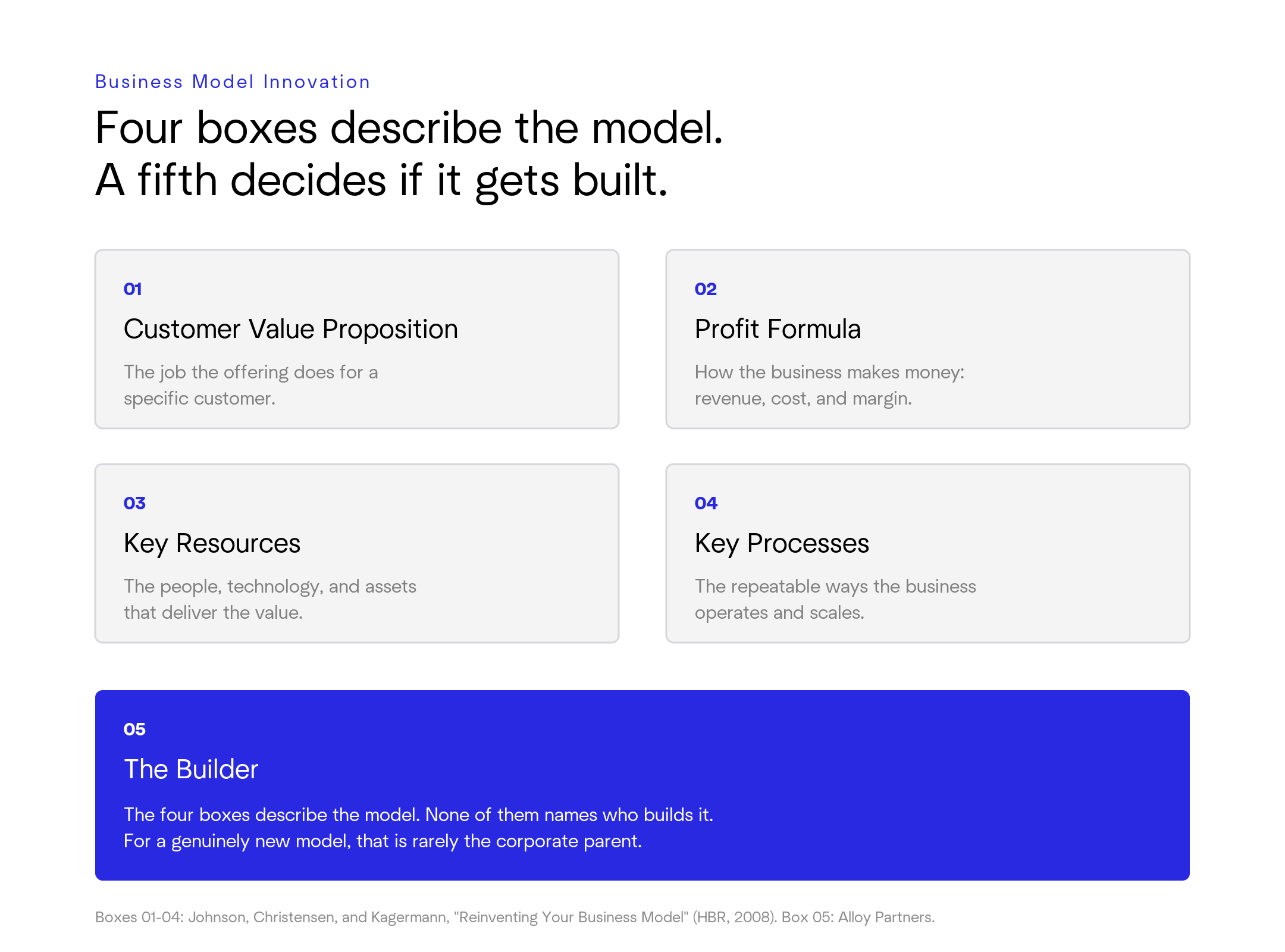
That is the fifth box, and it is the one corporate business model innovation skips. Teams spend months perfecting the four boxes on paper, then hand the result to the part of the organization least structured to build it: themselves. For a genuinely new model, the honest answer to who builds this is rarely the corporate parent. The real answer is the atomic unit of innovation: an entrepreneur in a startup, with the autonomy, urgency, and skin in the game a corporation cannot manufacture inside its own walls.
Co-creation answers the fifth box. The corporation supplies the advantages it has earned: distribution, capital, regulatory access, market credibility. A founder and a dedicated venture supply the structural freedom: a clean cap table, startup incentives, speed, and focus. The new model gets built where it can actually survive, in a separate company governed by startup rules, while still drawing on everything the corporate partner brings. That is corporate venture building: co-creating the new company with the partner whose assets it draws on.
This is the difference between innovating a business model and building one. The four boxes are a description. The fifth box is a decision about where the work happens. Get the fifth box wrong and the other four never leave the deck.
What does business model innovation look like in practice?
Two examples make the fifth box concrete.
Athian, with Elanco. Elanco is a global animal health company. The opportunity was a livestock carbon market: pay farmers for verified emissions reductions, then sell those credits to food companies working toward their own climate goals. The four boxes were a new model for Elanco in every dimension. New customer (food-chain buyers, not the existing channel), new profit formula (a marketplace, not product sales), new resources and processes (verification and credit issuance, not manufacturing and distribution).
There was also a constraint no internal build could solve. A credible carbon marketplace has to be a neutral third party. If the marketplace is owned outright by one animal health company, the rest of the industry will not participate, and a marketplace without the industry is not a marketplace. The model required independence from Elanco to work at all. So we co-created Athian as its own company. It launched the first livestock carbon insetting marketplace, built its verification engine, and drove more than $18 million in payments back to farmers for verified emissions reductions from 2024-2025. That is a business model that could only exist outside the parent.
Woodchuck, with NorthStar Clean Energy. NorthStar's core competency is producing energy from biomass. The opportunity was bigger than that core: turn construction and wood waste into renewable energy feedstock at scale. But sourcing and qualifying that waste stream required building hardware and AI to identify, sort, and route material, a capability set well outside what an energy producer does. Asking the core business to also become a hardware and software company would have buried the venture inside the wrong organization. Building Woodchuck as a separate venture put the new capability where it could be built and scaled on its own terms, with NorthStar's energy expertise and market position behind it.
In both cases the business model innovation did not happen in a workshop. It happened in the market, in a company built for the job.
Should you build a new business model internally or co-create it?
Not every new model needs a separate company. If the innovation extends your existing model to an adjacent customer with the same economics and the same core capabilities, build it inside. You have the advantages and none of the traps.
The test is whether the new model fights your existing structure. Ask the fifth box honestly. Does this model serve a customer your organization is wired to misunderstand? Does it run on economics your planning cycle will punish? Does it need a capability or a neutrality your parent company cannot provide? If the answer to any of those is yes, the internal build is the slow road to a dead pilot. Co-creation is how the model gets built where it can live.
Business model innovation is a verb. The companies that win at it stop workshopping the four boxes and start answering the fifth.



























































.avif)