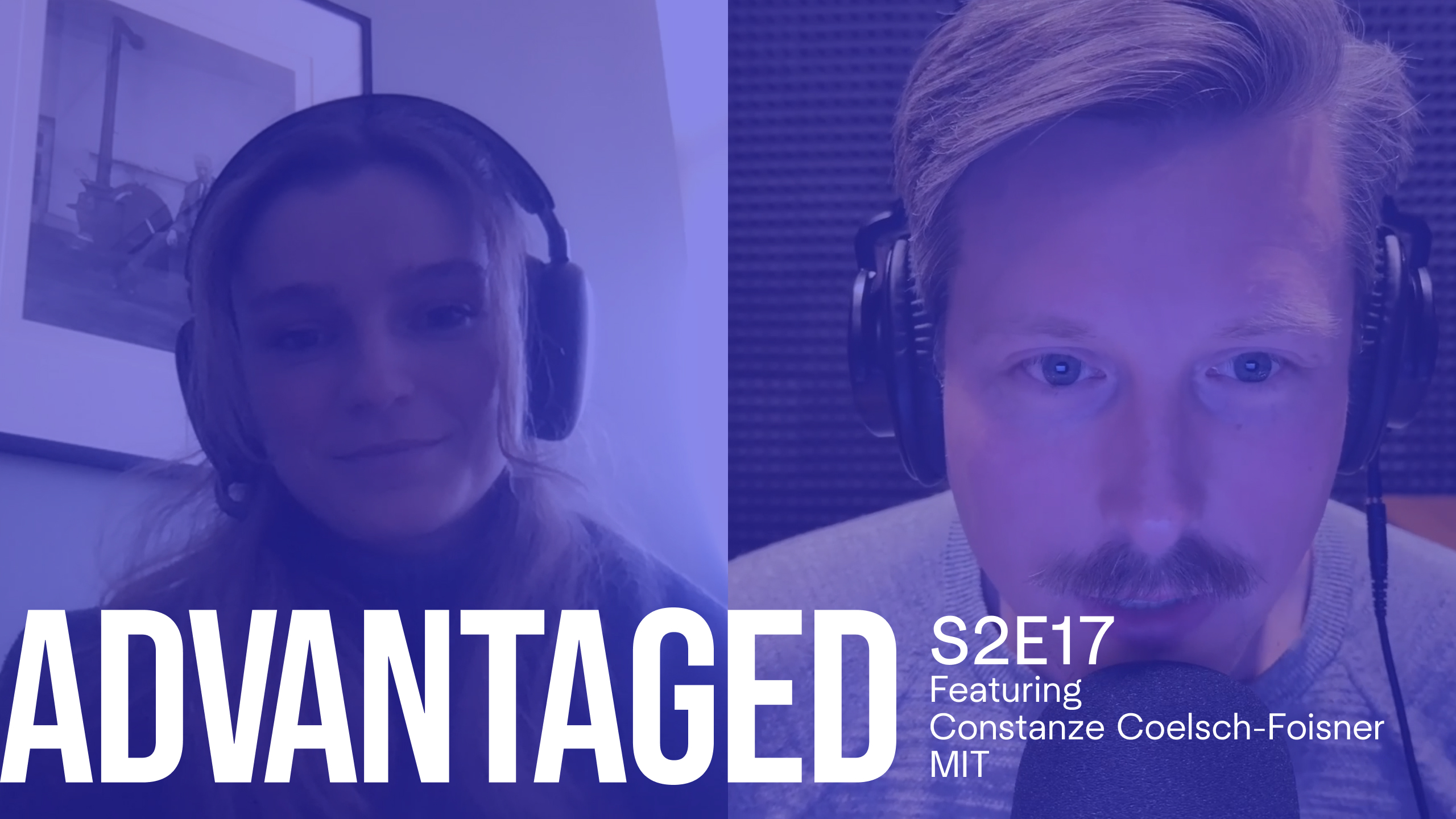
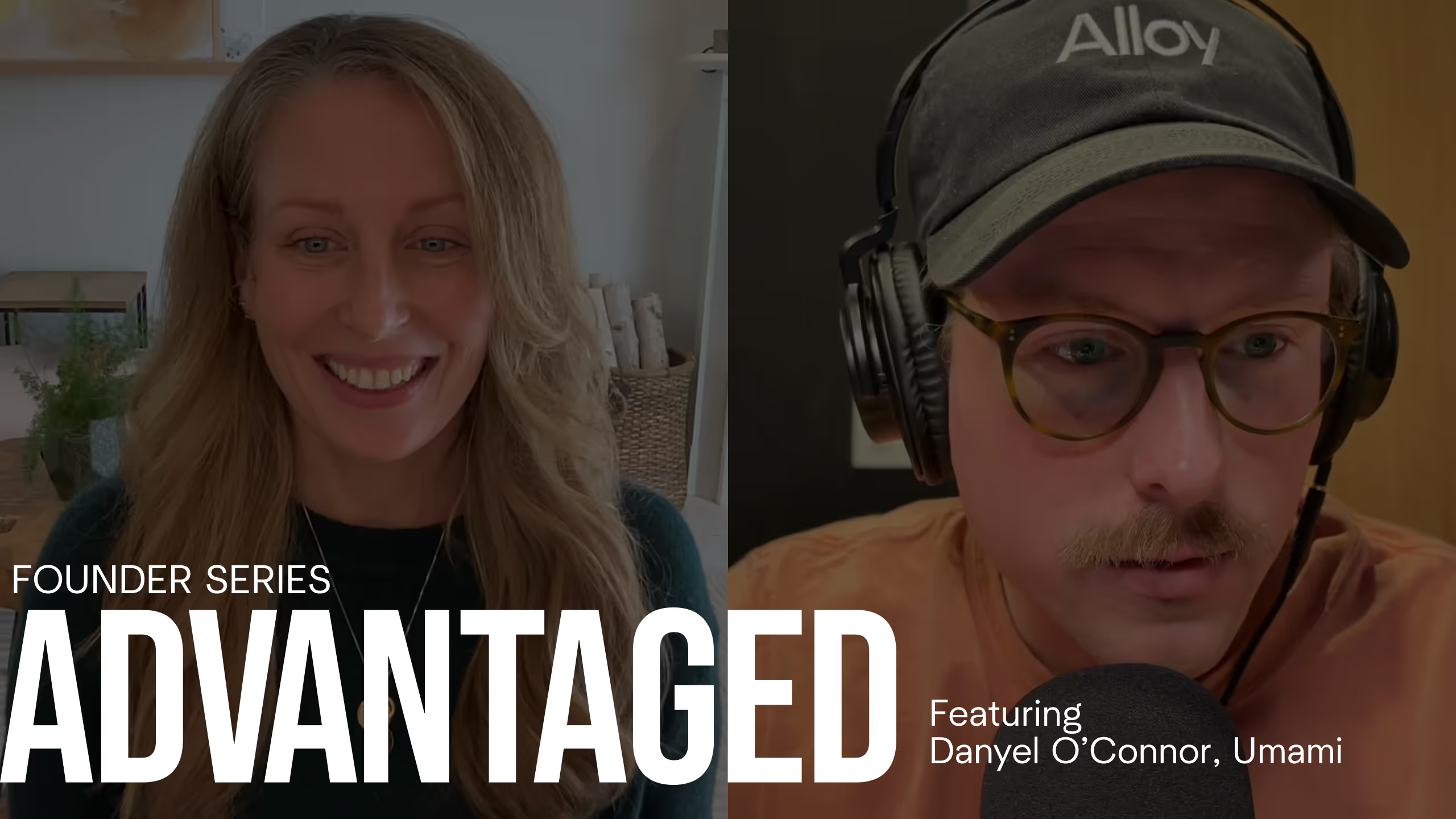
The phrase "venture studio" has become so elastic it doesn't mean much anymore. Agencies call themselves venture studios. Accelerators rebrand as venture studios. Corporates spin up something they label a corporate venture studio because the term sounds more serious than "innovation lab." That ambiguity makes life hard for anyone trying to decide whether to launch one, partner with one, or invest in one. So when Constanze Coelsch-Foisner and Fiona Murray at MIT Sloan published a paper in MIT Sloan Management Review distilling five years of research into a framework for when a corporate should actually launch a studio, I wanted to bring her on the show.
Constanze's path to this research is its own story. She started in petroleum engineering, moved through physics, did a PhD at ETH in management, technology, and economics, and is now a postdoc at MIT Sloan working with Professor Fiona Murray. Five years and 65 venture studios into her research, with more than 100 practitioner conversations behind her, she has spent more time than almost anyone systematically asking what actually makes venture building work as an organizational capability. Her published work includes the recent MIT Sloan Management Review piece on when to launch a studio and a Journal of Business Venturing paper called "Founders for Hire" on what really separates studios from accelerators.
We covered the framework at the heart of her paper, which is that every viable studio needs at least one of three resources (talent, intellectual property, or market insights) and that most corporates badly overestimate how much of each they actually have. We got into why corporate studios tend to die in CEO transitions, the governance misalignment that quietly kills viable portfolios, and why she thinks studios are structurally better suited to deep tech than traditional venture capital. She also pushed me on the "corporate as only customer" trap inside Fortune 500 studios, which is something I had not heard articulated this clearly before.
The line that stuck with me: "It's just not enough to say, oh, we have great people and we have some patents lying around that we think we should do something with." That single sentence is the entire problem corporate innovation leaders have to grapple with before they greenlight a studio.
Featured Guest
Dr. Constanze Coelsch-Foisner is a postdoc researcher at MIT Sloan, where she works with Professor Fiona Murray on the design and performance of venture studios. Her research spans 65 studios and 100+ practitioner conversations across continents and sectors, focused on how organizations can systematize entrepreneurship and translate science into companies. She is also part of MIT's Deep Tech Observatory project, which is mapping the components needed to commercialize deep tech innovation at scale.
Connect with Constanze on LinkedIn.
Key Takeaways
- One of the three resources is necessary, but none alone is sufficient. Constanze's framework names talent, IP, and market insights as the foundational inputs every corporate venture studio needs. Most corporates assume they have all three. Almost none actually do without bringing in outside help to fill the gaps.
- Talent is the trickiest of the three because entrepreneurial people inside corporates stay invisible until you give them a reason to surface. The objection Constanze hears most is "if they were entrepreneurial, why are they here?" Her research says they exist, but they need a vehicle. ASML and Philips' HighTechXL studio in the Netherlands is her go-to example of pulling internal entrepreneurial talent into a studio without losing them to the open market.
- Corporate venture studios usually die in CEO transitions, not because the ventures fail. BP Launchpad, General Mills, and G-Works all produced real companies before being shut down. When a studio is the sitting CEO's pet project, it does not survive a leadership change. The fix is making innovation part of the company's operating system, not the CEO's mandate.
- Killing fast is a metric most corporates don't measure, and it's one of the biggest reasons their studios underperform. Google X built peer recognition and bonus incentives around how quickly teams kill bad ideas. Most Fortune 500s evaluate studios on financial returns far too early. Strategic metrics, portfolio metrics, and explicit kill counts belong in the scorecard alongside revenue.
- Deep tech is where corporate venture studios have the biggest structural edge over traditional VC. Long timelines, multi-domain coordination, structured experimentation, and the ability to run multiple companies in parallel are exactly what deep tech requires and exactly what venture funds struggle to deliver. Constanze's Deep Tech Observatory work is built on the premise that the next set of industry-defining companies in fusion, semiconductors, and resilience tech will come out of studios, not pure funds.
Listen to or watch the episode below and be sure to subscribe to Advantaged, the leading corporate innovation and venture building podcast, on Apple Podcasts, Spotify, or YouTube.
Referenced in the Show
- "Is a Venture Studio Right for Your Company?" (MIT Sloan Management Review). Constanze and Fiona Murray's recent paper introducing the three-resources framework for deciding when to launch a corporate venture studio.
- "Founders for hire? The role of venture studios in breaking the individual-opportunity nexus" (Journal of Business Venturing, 2026). Constanze and co-authors on how venture studios systematically separate the founder from the opportunity, operating through a staged process where ideas are generated, advanced, or killed before a permanent founding team is in place. Draws on qualitative evidence from 16 venture studios and 50 interviews.
- MIT Proto Ventures. MIT's internal venture studio, used as the reference example for IP-translating studios.
- HighTechXL. ASML and Philips' Netherlands-based studio, cited as a strong example of pulling internal entrepreneurial talent into a venture studio.
Transcript
Below is an un-edited transcript from the episode.
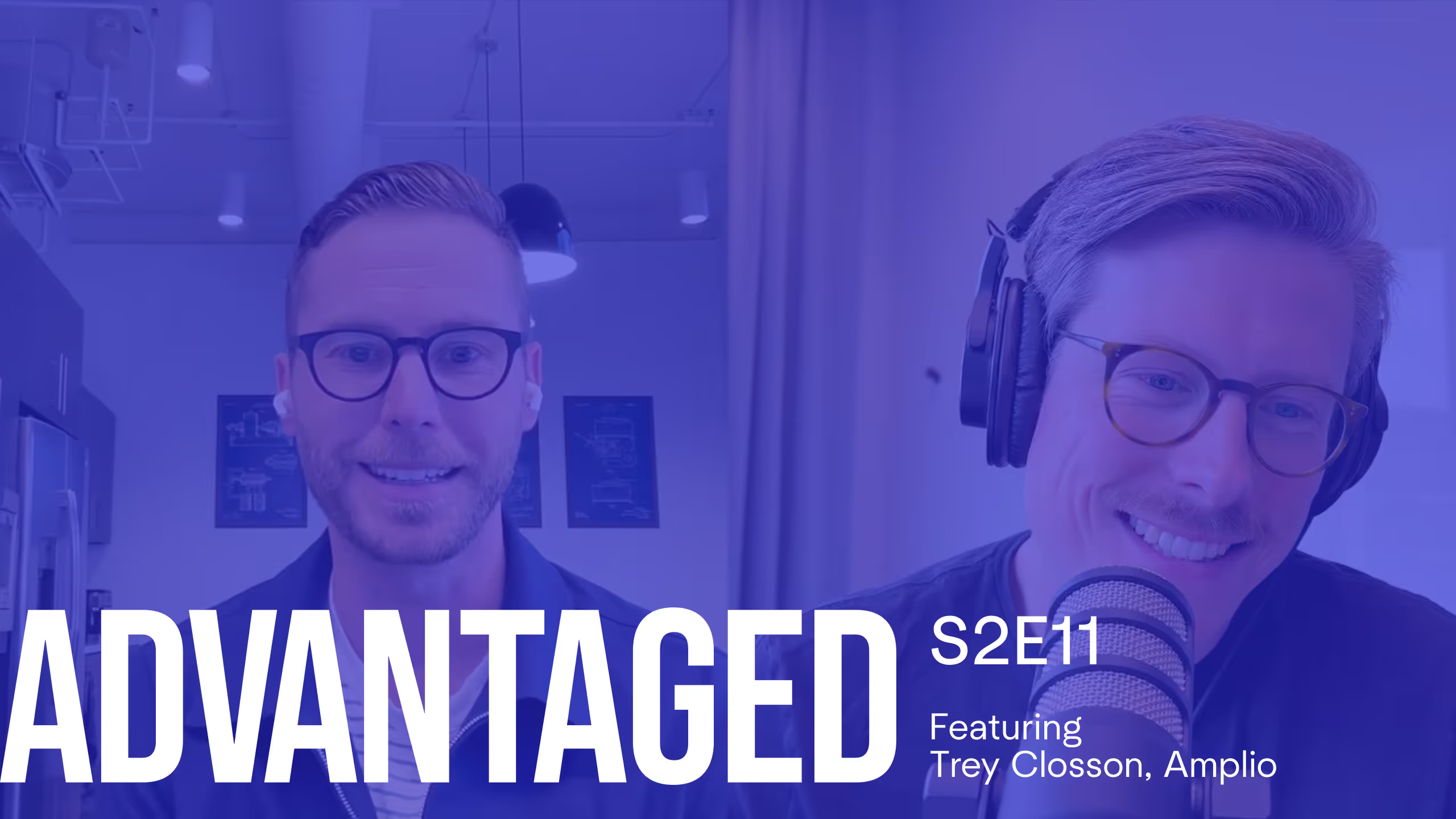
Drew Beechler: Welcome everyone to Advantage and Alloy Partners podcast. I am Drew Bechler, our VP of marketing here at Alloy Partners and your host of this
Drew Beechler: podcast,
Drew Beechler: advantaged. We are a venture builder and we partner with organizations and entrepreneurs to co-create startups and venture studios to unlock growth and transformation.
Drew Beechler: And on the podcast, we interview corporate innovators, founders and investors all around venture building, startup, corporate partnerships, and telling the stories of how corporates and startups. Together, particularly through this unique model around venture studios and venture building, and today we have a really special episode.
Drew Beechler: I am very excited to welcome Dr. Constanze Coelsch-Foisner, a postdoc researcher at MIT Sloan, who studies
Drew Beechler: a
Drew Beechler: lot around how these breakthrough ideas actually get commercialized, specifically through this lens of deep tech and venture building. She has been working on research around this for many years both at MIT and previously.
Drew Beechler: And so I'm really excited to talk a little bit about that research and your background and in particularly how this is being applied around deep tech. So thanks so much for joining me today. I really
Drew Beechler: appreciate it.
Drew Beechler: to open us I'd love to hear more about your background. You started in petroleum engineering, if I'm correct. Moved through physics and are now at MIT Tell us a little more about your journey and what's kept pulling you to this intersection between science and entrepreneurship and science and startup
Drew Beechler: building Really.
Constanze: So
Constanze: I actually got into business because my high school economics
Constanze: teacher told me that I was a strategic thinker.
Constanze: and I ended up taking a bunch of classes in university between science
Constanze: and business.
Constanze: Amongst them were astrophysics and energy politics. I then ended up briefly working at an oil company, and I quickly realized that I was actually more interested in the application side of things on the macro scale as well.
Constanze: And I was also more interested in different kinds of technologies that were a little bit more resilient and a little bit
Constanze: more self-sufficient.
Constanze: And then after my master's, I was thinking which
Constanze: direction I wanted
Constanze: to go into, whether that was.
Constanze: Astrophysics or actually business and I ended up reconnecting
Constanze: with my university
Constanze: professor.
Constanze: I was offered a PhD
Constanze: at ETH
Constanze: at Mtech, which is short for management technology and economics.
Constanze: And so that ended up being an easy choice to do the PhD and. I've always operated from the fault of you cannot have business without
Constanze: science. And these two for me, fundamentally go together. And if you combine them actually in a way that
Constanze: makes sense the possibilities
Constanze: are really big. So I
Constanze: think though, that why a lot of these sort of science driven businesses, why they fail, is because there are allocation and coordination issues.
Constanze: And
Constanze: I think the question is really how do you combine scientific research with entrepreneurship in a way where you can bring these scientific interventions to the market to actually tackle these really big challenges? And yeah, for me it really was just way to bring these two things together because I believe that.
Constanze: Venture studios are such a
Constanze: model to help us coordinate and allocate resources efficiently.
Drew Beechler: Yeah, it's and it brings us into a good, into our connection. You recently published. A paper and some research that You have been working for many years. with Fiona Murray at MIT. Been, five years in the making. Many conversations many studios that you've researched across continents and sectors. recent paper at least you published, We were sharing it around and loved the framework that you put together and the paper. And so that's how we got connected, just talking about research. and so I wanted to spend, a little bit of time talking more about this and before maybe we get into kind the framework, just what made you spend, the last five years working around this particular question of, building startups within Venture studios. And what's surprised you the most, maybe out of what you found?
Constanze: so we just published this article that is based on my research from 65 Venture Studios
Constanze: and
Constanze: a
Constanze: hundred plus conversations in the Sloan Management Review. And so that was really a way for us to showcase. How
Constanze: can leaders decide under what circumstances of interest do you make them? My initial motivation to spend five years on that was actually quite ambitious.
Constanze: I wanted to understand if we can systematize entrepreneurship, because if we can do that, then we can actually say that venture creation can move from the sort of rare founded dependent event to something that can be done organizationally and systematically. And that opens up a lot of possibilities.
Constanze: And that sort of brings me back allocation coordination aspect. That's also how I got really interested in corporate innovation because I realized that corporates and large organizations, they often have the resources required to fund innovation, but a lot of times they get stuck in what we call the innovators dilemma, which means that they have the resources.
Constanze: To do a
Constanze: lot of things,
Constanze: but these resources are not coordinated or allocated efficiently.
Constanze: Then so venture building can actually be applied to that dilemma. I mean, we've seen A lot of different solutions come out over time that is also trying to tackle that dilemma from corporate venture capital to corporate accelerators and incubators and hackathons. And there's so many things that corporates dabble with, but we see that most
Constanze: corporates actually have
Constanze: an innovation function, and the real question is how, based on your strategic goals and your resources, how do you execute innovation in your organization? In terms of the surprising insight, I wouldn't say that there surprising because it is all quite aligned with the innovator's dilemma. So one thing that I will say is the patterns that I've realized is when things go wrong, they tend to spiral. And when well that compounds, and it's the thinking that the worse it gets, the worse it gets, the better it
Constanze: gets, the better it gets.
Constanze: But it is all amplified by the sort of irrational
Constanze: actor, which is the human being.
Constanze: and. What I realized is that you can have all the structures in place and you can have, in theory, the perfect venture studio and
Constanze: corporate
Constanze: internal innovation unit. But if you don't have the people who can actually execute in a way
Constanze: that moves
Constanze: the team forward, it's
Constanze: not gonna work.
Constanze: And I also realized how siloed large organizations are and how siloed the knowledge and the people, in these organization is. I have a sense that has become
Constanze: a little bit more complex with sort
Constanze: of working from home and a flexible work structures,
Constanze: which is good in some ways, but it also creates more challenges for teams to work together. Another thing I've. realized that just a term venture studio is just ill-defined. And so everything is labeled a venture studio, right? And an accelerator that is
Constanze: actually an accelerator is a
Constanze: venture studio. And there's a lot of noise and hype
Constanze: around it.
Constanze: And that actually scares investors
Constanze: sometimes
Constanze: because they don't know what they're investing in.
Constanze: Is it an asset class or is it just a mislabeled accelerator?
Constanze: And so part of my work was also just
Constanze: really trying to bring clarity. And it is, from a research perspective, a very new and understudied phenomenon. I think in practice we've seen similar things happen, but they have been labeled differently.
Drew Beechler: I completely agree. I think the term venture studio has been completely disassociated, kind of at least my.
Drew Beechler: Thinking in definition of the term. And I think part partly there, there's a handful of reasons, but one of the reasons I believe is that anyone can call themselves a venture studio because it's amorphous, almost. And you think about a venture fund. It very clear definitions. Not anything can be a venture fund. It's actually regulated in a very specific function, even from the SEC where like a venture studio can be an agency that just calls itself a venture studio and is a product design agency. Where a
Drew Beechler: venture fund is very concrete around, there are assets under management. You are usually managing other people's money.
Drew Beechler: You are deploying those assets you know, there's a very standard business model two and 20 from a management fee and carry, you know, this, follows very traditional patterns, funneling up into private equity as a holistic class and venture studio industry, if we wanna call it, or asset class but I think because it doesn't have much of. The structure around it, people have been able to use the term however they would like.
Drew Beechler: And so I do think that's become challenge and in my mind at least, but I'd love to hear your, definition as well, but I think the most simplest definition of a venture studio is a company that systematically creates new startups from scratch. And I think the main kind of definition and core components of that are, creating startups from scratch.
Drew Beechler: With built-in capital there have been incubators and things like that over the years, startup Studios, but they haven't had built-in capital deployment to in those entities from the beginning. And I think that's where, the venture part of a venture studio comes from. And the studio part is this idea of starting companies from scratch.
Drew Beechler: Usually ideas that are. Generated within the studio itself. But anyway, that, that's always been my definition. So I see lots of, uses of the word venture studio. know what your research has is now found. Some people say there's a thousand plus venture studios around the world that are operating of those.
Drew Beechler: How many kind of fit the definition of have they launched, more than one net new startup with capital attached? I don't know how many kind of fit into that but I, do think it's been a challenge What is the end goal of all of these together? And sometimes when we're talking about venture building and running a venture studio, we're
Drew Beechler: not talking about the same things in this
Drew Beechler: world.
Constanze: I think that's right. And that's why I think the definition is actually really important to get right. And I agree with you on that. It is around creating companies from scratch and we had. Sort of A fault of
Constanze: Venture Studios, decorate de novo and
Constanze: de alio, meaning that some really create from nothing. And they hire founders.
Constanze: So we just published a paper in the Journal of Business venturing on that called Founders for Hire. And that is quite interesting, right? Because no other
Constanze: organization does that.
Constanze: and that's really the thing that sets a venture studio apart
Constanze: actually.
Constanze: Whereas if you have the delio, meaning building from something, you often have founders coming to the Venture Studio with an already idea and the Venture Studio scales it or takes it a step further.
Constanze: And I think that's probably more to what we see. Accelerators too. Doesn't mean that doesn't make it a venture studio. It's just to us it's a different type of venture studio. And then if we think about deep tech that's really around ip and who owns ip, who generates ip, who translates it?
Constanze: And so
Constanze: we came up with this sort of
Constanze: terminology of IP translating, IP generating and service providing studios. For me, a venture studio, in addition to creating companies from scratch, it is around the recombination of ideas, people and resources. In a way that creatively changes something initial, right? It can be initial, it can be really from scratch. And so it is a very dynamic model, which comes with its own challenges because it can be adapted to different contexts and people interpret it differently. And it doesn't mean it's not a venture studio,
Constanze: it's just a different interpretation or adaptation of
Constanze: the model.
Constanze: But I
Constanze: think.
Constanze: Getting the sort of key pillars in place and getting that right is actually very important so that we
Constanze: Speak the same language, right?
Drew Beechler: how are we comparing?
Drew Beechler: Apples to apples and the asset class as a whole. in the MIT Sloan paper that all recently published, you talk about the three core resources three core inputs, talent, ip, and market insights that organizations have.
Drew Beechler: You say that most organizations don't honestly assess, which of these they have and maybe even They may have them, but maybe they might not be able to.
Drew Beechler: Effectively leverage them or use them or have access to them in the right way. So maybe walk me through those kind of core inputs a little more and help me understand, what does it look like when an organization has genuinely identified these resource advantages versus,
Drew Beechler: When they're just telling themselves that they
Drew Beechler: have these.
Constanze: So our point was that one of
Constanze: these resources is necessary
Constanze: but not sufficient to start a venture studio. And maybe we can link the article as well. If
Constanze: that's
Constanze: possible.
Drew Beechler: your other,
Constanze: most organizations, as you said,
Constanze: too.
Constanze: they don't actually take a hard look at what they have, what they don't have.
Constanze: And they assume they have all of them, but that's almost never happens. So. Talent, for example, that's actually, it's not just
Constanze: about having smart people, it's about having people
Constanze: who can actually operate entrepreneurially under uncertainty and build something new. And so the way you would see that is by doing. Internal capability assessments, you would try to identify teams that have excess capacity. maybe excess technical capacity. They have very specialized knowledge Or repeatable, excess knowhow that can be
Constanze: identified.
Constanze: And also, talent is actually a really hard one because a lot of people. Actually, a lot of people have told me if there's people in the organization that
Constanze: are entrepreneurial, why don't they
Constanze: just do it somewhere
Constanze: else?
Constanze: That doesn't make sense. Why would they be in a corporate in the
Constanze: first place?
Constanze: And I've made the discovery that there is actually
Constanze: genuinely entrepreneurial talent
Constanze: in an
Constanze: organization.
Constanze: It's just
Constanze: a matter of
Constanze: drawing them out. And I think a venture studio can be a way to actually help internal entrepreneurial talent create something that aligns with
Constanze: their entrepreneurial goals so that
Constanze: you don't lose such talent. And I think A SML, for example, and Phillips, they have a venture studio called HITECH xl. It's in the Netherlands. They've done a very good job at that, where you have internal employees who are engaged in the venture studio. They are very interested in helping the studio succeed, not just with internal ip, but also with technical know-how from the corporate.
Constanze: And then at the same time, you also have a trajectory for entrepreneurial individuals to move towards entrepreneurship in that venture studio. The second one was intellectual property. And so that is around having technologies or knowledge that is
Constanze: differentiated or underutilized.
Constanze: So these are
Constanze: things that
Constanze: you think can be translated into real world applications, but haven't
Constanze: yet
Constanze: been translated.
Constanze: And one thing
Constanze: that
Constanze: corporates do is
Constanze: actually they do IP auditing and sort
Constanze: of portfolio audits of underutilized technologies. We say that, for example, for Proto Ventures, which is the MIT's internal venture studio, we said that it's around 70 to 90 technologies that a venture builder can assess per year.
Constanze: So
Constanze: if you don't reach that capacity, it probably doesn't make sense to engage a venture builder or an EAR. Nokia. Bell Labs also did something
Constanze: very similar.
Constanze: They have a lot of technologies. They don't
Constanze: really know how
Constanze: to market or commercialize them,
Constanze: so they brought in
Constanze: E to actually help them identify
Constanze: where a good place in
Constanze: the market would be for their technologies.
Constanze: And market insights are the third one, and that's really
Constanze: around having
Constanze: unique access to data, customer problems, or patterns that others simply don't have. And our example in the paper was Chalhoub which is a
Constanze: Middle Eastern
Constanze: retailer of luxury goods. And so
Constanze: they actually, they have a lot of
Constanze: insights from around 400 clients to build these ventures based on their strategic priorities. The way you would assess if you have that is if you have proprietary data sets, certain usage patterns or operational signals that your competitors don't have. I think, an advantage is always something that
Constanze: is identifiable, measurable, and differentiated. So
Constanze: it's just not enough to say, oh, we have great people and we have some patents lying around that we think we should do something with.
Constanze: The question is really around whether those resources can serve as the foundation for building new companies,
Constanze: and then you might have
Constanze: to bring in external talent
Constanze: to identify that like an EIR or a venture builder.
Drew Beechler: You talk a little bit about, it's rare for an organization to have all three internally, that the most effective studios are, hybrids of bringing in what they're missing? how does an organization know when to build the capability internally versus bringing in the outside partner?
Drew Beechler: Or where do you see that go wrong in making that assessment as
Drew Beechler: well in your research?
Constanze: Yeah, because Alloy Partners is actually a venture building
Drew Beechler: Yeah, it's very selfishly we, we do this often, so it's, I think it's, it's helpful we get the pushback a lot of, internal studios. That have been running and, and, and aren't running very effectively. And they come to us and, and they say, how are you able to, launch X amount of companies a year come and help us And I think what they struggle with is, most companies, their default is, we should do this on our own. This should be an internal capability that we should own. And oftentimes we're talking to them. After the fact usually. And so, I think that that's where helpful just to, how should corporations be more, reflective and introspective around, taking a, a look in the mirror and saying where do we actually have gaps here?
Constanze: I think it's always really helpful to bring in external perspectives, whether that's. A venture building partner. It might be an EAR, it might be portfolio founders that are external and that can shake things up a bit. Because what you need is you need a fresh pair of eyes sometimes on, on these matters
Constanze: because I think
Constanze: large organizations are sometimes very
Constanze: biased,
Constanze: and that's what we've seen a lot is that they think they have something, but then there is.
Constanze: Just not enough of it. It's just a fault
Constanze: and
Constanze: it's a way of perceiving themselves as an organization.
Constanze: So I think the there's a way to do this well in collaborating
Constanze: with external partners
Constanze: and where it goes wrong is actually in the evaluation of an organization and the integration of externally developed ideas.
Constanze: So
Constanze: when I say the evaluation
Constanze: of the organization is that an external partner obviously does not know
Constanze: the organization as well as the corporate itself does. And so sometimes it's really hard for an external partner to identify. The assets the organization has or what
Constanze: is actually possible or what it is not going as well because maybe the corporation
Constanze: is not as honest, maybe they just simply don't know themselves. And so there is a lot of work that an external partner has to do. And I know that because I've worked with organizations myself and when we talk about how to design a venture building program, or how to change it and how to do
Constanze: that in a way that is efficient.
Constanze: a lot of times I come in and I'm, I, there's just not much to work with.
Constanze: Which is fine, right? Because then you can actually do your own assessments and evaluations. And I
Constanze: use a mix
Constanze: of quantitative and qualitative data to actually understand how well the organization is doing and what is feasible in terms of venture building. And
Constanze: then you can compare that to.
Constanze: knowledge from the field of what are other venture studios in the same field doing, and how can you then apply that to that organization that I would work with in terms of integration it's really around, for example, if in your case you are building a company externally, how is that being integrated back into the corporation?
Constanze: And so. sometimes what we see is that the governance mechanisms and
Constanze: structures are actually not aligned
Constanze: in a way where.
Constanze: the corporation can absorb and connect those ideas back into the corporation. And so the whole system breaks down and or it gets lost. Right? And that's oftentimes very sad, which is more of an acquisition base because there's a lot of value and work that has been done, and then it just sort of ends up. dying in the organization.
Constanze: So I think thinking about what the company, if it is a more of a company
Constanze: acquisition, right? What that purpose of that company would be once it's inside the organization, that's very important. And having the right governance processes in place.
Drew Beechler: I completely agree. I think a lot of it depends too
Drew Beechler: on.
Drew Beechler: what is, yeah. The ultimate goal of the studio in the
Drew Beechler: strategic
Drew Beechler: vision for the company. Is it around learning? Is it around growth? I think our position and where we work really well, is Always around external venture building. And so we want to build net new startups that live outside of the corporation that leverage the governance, the equity structure, the lack of rules and governance. and regulation even that exists usually at the, large corporation
Drew Beechler: But that a startup can move at startup speed and at startup rules and be able to do things that, that the corporation could not.
Drew Beechler: I mean, One, one great example of right now is, everything just with AI and agentic, systems and open claw and everything no. Fortune 500 is going to let that run rampant in the organization and they shouldn't. Where a tiny one person startup, has more or less nothing to lose.
Drew Beechler: You know, They're trying to live or die by, can we make it out into market and find product market fit? And there's just a whole different level of, scrappiness and inability there in
Drew Beechler: that startup in your research, you've gone over some cautionary tales as well. You have a handful of examples. a BP Launchpad, general Mills, G Works, despite producing. Viable new ventures have all been, spun down.
Drew Beechler: Usually after strategic direction, has changed or executive buy-in has changed. But what do the ones that have gotten killed over the years, have in common? And at what point in a studio's life does it become, survivable where the leadership can't just pull the plug anymore?
Drew Beechler: And what, what are some lessons. That you can provide to, to other folks either looking to start brand new studios within corporations or that are running studios today around how to use those cautionary tales.
Constanze: I think that's a really interesting question because what you also said is that well, actually they did have viable ventures, right? And so the issue is then not formal. Because on paper they do what they say they should do. It's more structural. And so I think often what we've seen is that there can be a lack of long-term commitment.
Constanze: Venture billing just takes time. It's a five to 10 year commitment at least, and corporate priorities can shift very, very
Constanze: fast. And then
Constanze: you also mentioned leadership changes, right? Huge one because a lot of times the corporate. Venture Studio is actually a sort of pet project of the CEO and
Constanze: if the CEO changes,
Constanze: obviously that PET project won't
Constanze: survive, and these units are usually the first ones that get cut.
Constanze: If funding changes priorities changes, or if the CEO changes. And it sort of leads me to my next point is when the CEO changes, it's really an issue because. That means it has not become everyone's
Constanze: priority, right? If
Constanze: that was a pet project, solely pursued as a pet project, but venture building should be everyone's business and innovation should be ingrained in the company.
Constanze: So everyone has to be equally involved and onboard. I think there's a cultural aspect to that too, right? That innovation should be really everyone's business and internal venture studios should also be internal, not operating
Constanze: somewhere on the outskirts unless
Constanze: people are operating with someone like you, right?
Constanze: Sort of a bridge between external and
Constanze: internal.
Constanze: That's a different scenario, but I'm talking about if
Constanze: you
Constanze: want
Constanze: to have an internal venture studio, that should be
Constanze: some. place where a venture studio is
Constanze: actually linked
Constanze: to the corporate in order to utilize the corporate's data and resources and access and also legitimacy.
Constanze: And not some weird experiment that is just not really integrated very well. And I think culture also within the studio needs to be sort of scrappy and testy and experimental. And I think what you said earlier around the fact that well, of course corporates wont, don't want to integrate it because it's very risky in the beginning.
Constanze: I think a venture studio can be an ex excellent way to actually be an entrepreneurial testbed and to commit a few resources, kill fast and experiment. And I think this like aspect of killing fast is actually really important. And we
Constanze: see that there are some venture
Constanze: studios that do this really well. For example, Google X, right?
Constanze: They have this whole culture of killing things fast and rewarding them through peer recognition. and, and bonus incentives, right? So the people that proceed fast and move along fast they actually
Constanze: get rewarded, which
Constanze: is very rare
Constanze: in corporate cases. But
Constanze: I think adopting such
Constanze: a culture is actually very helpful and I think. Maybe the third thing that we can learn is actually governance misalignment, is that studios are often expected to operate entrepreneurially, but they are. Evaluated by corporate
Constanze: metrics
Constanze: that don't fit the model at all. And that goes back to this entrepreneurial test bed analogy, right? how would you measure if something like that is actually successful?
Constanze: And the way we say you should do that is actually not just by financial metrics, but maybe by strategic metrics, right? Like how many partnerships did you build? The portfolio metrics, how many ventures were launched, but also how many ideas were killed in the process. And I
Constanze: think
Constanze: there's also a learning aspect to that, right?
Constanze: Organizations can do this in order to learn about entrepreneurship and there is a sort of messiness component that should be considered when you do that. The real questions I think organizations need
Constanze: to just ask
Constanze: upfront is not just, can we do
Constanze: this right? Do we have the resources, but can we actually commit to this long term and can we make the organizational changes that a
Constanze: model like
Constanze: this would require? And I think there's easier ways to do innovation, right? it's very long term. It can be resource intensive, but it could just start
Constanze: with an EIR program.
Constanze: But there is,
Constanze: it's a big commitment still to have
Constanze: a venture studio. I think venture building is just
Constanze: one of the most demanding approaches to innovation, and it just should be considered carefully if that's something one wants to do.
Drew Beechler: I couldn't agree more. I think oftentimes in our business that. We have picked the hardest lane to operate in. and, in one of the hardest sectors, it's 10 times easier to just be a venture capitalist. but we decided that we wanna do this the hard, hard mode only. but our thesis is that we think though that the companies that we can start, the portfolio, we can build because.
Drew Beechler: It comes attached to these amazing corporations and the advantages that they bring to these companies. It makes the portfolio so much more valuable. and that is the unique unlock in our proprietary deal flow and our unique nature that can provide, returns. Outside , what we see just within traditional venture.
Drew Beechler: And so, it is hard mode, when you pursue this path. And I think it's something worth, worth saying out loud We've spoken here the last handful of minutes, particularly just around the corporate angle of this. You're doing a lot of work now with MIT's Proto Ventures as well which I've had a handful of their venture builders and team and talk to them on the podcast even as well, which is a ton of fun to, to dive into more on the deep tech side of things is some of the ideas that they're working on.
Drew Beechler: You've studied, venture building on both sides of this, corporations and universities. Maybe share just a little bit from your perspective on what does a university have that a corporation can never fully replicate, and what do corporations have that the universities never fully can replicate?
Constanze: Yeah, I'm so happy to be so well represented that, that's great. I think universities fundamentally have a lot of ip and there's a lot of knowledge and there's this constant influx of talent. But what we see, and that's part of my research, is. They have a hard time commercializing the scientific inventions into commercial applications.
Constanze: And for instance, proto Ventures doesn't promise or take equity, which actually is very nice for the PIs of the labs and the students because it creates interest and motivation because they don't need to give anything up. But that also makes it harder when you're trying to partner with corporate partners.
Constanze: And I think on the other side of the spectrum, it, you have corporates that have structures that are aligned with profit, but I think a lot of times it might be a little bit less relevant because they don't have that. They have their structures in place and. Are somewhat profit making machines, but sometimes you can lose sight of what is actually happening in, in the wild and in the real world.
Constanze: So for instance, I was recently working with Fidelity, and Fidelity is its own market, right? I even if the company builds a company inside the company. It can survive just by serving fidelity. And that's a really interesting thought, which a lot of startups a lot of startups just have to go to different types of partners and they have to experience who is my customer actually.
Constanze: And I think that is the change or the difference when it comes to building within a corporate. I think venture studios. Essentially sit between that world where you try to be profit aligned, and in the cases of deep tech and research driven innovation, you also try to actually get people interested that are constantly creating new ideas.
Constanze: And proto Ventures is an example of an organization that has tried that. I think if designed well, this can work because in an ideal scenario. Corporates can fund such studios on campus without immediate pro profit or equity commitments. But then as we've seen that is oftentimes a little bit hard, right?
Constanze: So for example, proto Ventures would mostly take philanthropic funding because that's just more aligned with profit interests. But I do think, and that's something we're working on, is designing a model that can suit both needs. And that's really the crux of it, right? Is can we try and design something that serves both worlds?
Drew Beechler: I have been using this term internally a lot around research co-creation. We work with and partner with and co-operate a couple of university based venture studios one of which is with the University of Notre Dame called 1842. And we talk a lot about this idea of research, co-creation of working.
Drew Beechler: With researchers at the university and co-creating these startups with industry partners at the same time. And we've done that a handful of times, there's something magical there where the university is flush with IP and ideas and technology that is just sitting on the shelf.
Drew Beechler: And how do we translate that into commercial viability and bringing along industry partners that have the market insights, that have the problems uniquely that they see is really powerful. Aligning those two though, to your point, because of the nature of their, business models of their mission.
Drew Beechler: At the end of the day can be hard sometimes, but it is something that we continue to endeavor to do and and is a unique spot to be in. A lot of the examples that show up in your research a lot of your background, even in particular are centered around deep tech nuclear fission and semiconductor cooling, carbon capture.
Drew Beechler: Hard sciences. How does the Venture Studio model adapt when you're building in deep tech in particular, and do you think studios are actually maybe better suited even to that world than traditional, consumer based applications and B2B software in traditional kind of venture capital that's been funding those types of products for decades?
Constanze: I think in some ways they are, and I think you are a good example of that, right? Where you collaborate with universities and you try to bring in corporate partners in the research corporation. I think if they are designed correctly deep tech and venture building are actually, they go hand in hand because deep tech requires these like really long timelines, high funding coordination across multiple domains and structured experimentation.
Constanze: Whereas traditional venture capital, they often struggle with. This fact that a lot of it is heavily founder dependent and also they're used to shorter time horizons than deep tech is. I think Venture Studios, by contrast, they allow you to build multiple companies in parallel, systematically test ideas, and then you can allocate these resources in a dynamic way.
Constanze: So it's a little bit more flexible. And what we've seen as well is that you can actually create whole industries with debt. For example, if we take fusion technology, that there's many components that are missing in order to create a fusion reactor, right? And if we understand the components that are missing, can we then create these components by ourselves?
Constanze: So it's around ecosystem building actually, which a VC doesn't do. An accelerator. They accelerate existing ideas, but a venture studio, there's a little bit more planning and strategic foresight in that. So I think what I've found is that model can be particularly well suited for tackling, really complex, high uncertainty problems.
Constanze: And that's also where a lot of my current research is focused, right? Is like how we, a building can actually be used as a mechanism to address these large societal challenges. And me and my professor professor Fiona Murray, we are doing a project on what we call the Deep Tech Observatory, where the idea is to actually map out different types of data and data layers that go into such deep tech companies.
Constanze: And the question is that if we believe that a deep tech company or that a company is different resources and we believe that a venture studio can recombine these resources, can we map out these separate resources and lay a path for recombination to address specific challenges In our case, those are security challenges or resilience challenges.
Constanze: But could be anything really. And that's really my thought on can we then design models and systems where you can match solutions and problems more efficiently. Which I think what is what Ave Studio allows us to do.
Drew Beechler: it's the ecosystem opportunity is huge. The compounding the ability to run things in parallel. We're finding that right now we're about to publish, a piece here today actually around one of our studios and we're, in parallel running nine different concepts.
Drew Beechler: specifically focused on plant, animal, and human health in the convergence of these three. And I would say the stage gates are just, they're very apparent too. where in software they're not quite as deterministic at least. And so I think that's too and unique within. Hard tech and deep tech. you can run a lot more of these in parallel.
Drew Beechler: And I think things like AI and where we're heading in the future make that dramatically more cost effective as well dramatically shortened the life of. Being able to come to those aha stage gate moments as well. And so I think there's a lot of opportunity there for these studios to build really unique and novel solutions to some of these things, which is a ton of fun.
Drew Beechler: I have one closing question, around just where do you think Venture Studios are going in the future? Do you think this becomes a more standard part of. An organization or university's innovation portfolio or do you think this becomes more of a niche tool that companies will try or that will sit on the outside, but where do you think, what is your, based on all the research you've done where do you think this is heading.
Constanze: I think the term venture studio might evolve over time. We're seeing a sort of evolution, right from incubator to accelerator to very hands-on accelerator to Venture Studio, and it's this notion that capital alone is no longer enough, or network alone is no longer enough. There needs to be a sort of hands-on aspect to things.
Constanze: I think that aspect is really around the curation and the pooling of resources, people and ideas. Because an amazing person might not have the idea, but if you combine those two that's already venture building in some ways I think the real thought that we've had is. That the real advantage is actually shifting towards something that can be systematically coordinated and translate resources into new companies.
Constanze: And I think that is happening already. That will continue to happen. And we're seeing that happen more and more with deep tech, especially in areas. Around that, but also in areas where resources are scarcer because you need more sort of coordination and I think it's a much more organizational capability rather than an individual one.
Constanze: And so it's just a sort of testament of the evolution of how these structures have changed over time. And I'm not sure you know what the next 10 years will hold. I think AI is a very interesting capability and it will also accelerate venture building capabilities as well. And I'm excited to see actually how that will all play out and how it will impact it.
Constanze: My hope would be that venture studios become their own asset class with a sort of set rules of definitions and set structures so that we all align and also that, there is a little bit more regulation in that area because I think right now, as we mentioned before, there's just a lot of noise still, and that is historic, but it's also, I think it's still ongoing.
Constanze: And so having clarity around that will be a good thing.
Drew Beechler: I just wanna say thank you again for. Time. Thanks for spending time with me unpacking a lot of the research you've done over the last five years. It's been incredible to get to know you and this is an amazing conversation. So thank you so much. I appreciate it.
Constanze: Thank you so much for having me. This was very interesting.
















































.avif)