For most of the last century, defense technology and commercial technology developed on separate tracks. Defense labs built things that eventually trickled into civilian life: the internet, GPS, weather satellites. Commercial companies built things for consumers and enterprises. The two worlds occasionally intersected, but they operated with different buyers, different timelines, and different rules.
That separation is gone. And most corporate innovation leaders haven't fully reckoned with what that means.
The blurring of civilian and defense technology
Technologies originally built for commercial markets (AI, logistics software, cybersecurity infrastructure, cloud platforms) are now foundational to national security. And technologies built for defense contexts are increasingly deployed in civilian infrastructure. The distinction between "a commercial product" and "a dual-use asset" has effectively collapsed.
A 2025 analysis by Mind the Bridge identified 17,619 dual-use tech startups operating across NATO countries, representing 27% of all startups analyzed. Roughly 70% of new startup investment during the study period went to companies building technology that serves both commercial and defense buyers.
The clearest live example is playing out in AI right now. In March 2026, the Pentagon designated Anthropic a supply chain risk after Anthropic sought assurances that its models would not be used for fully autonomous weapons or mass domestic surveillance. The government declined to give them. Defense contractors began removing Claude from their workflows almost immediately. Whatever you think of the underlying dispute, the practical reality is this: a commercial AI product became critical infrastructure for national defense, and when its status changed overnight, organizations across industries absorbed the disruption. When the infrastructure underpinning AI shifts, every industry that depends on it absorbs the shock. And every major industry now depends on it.
The implication for corporations is direct. When commercial technology becomes foundational to national security, the line between "defense company" and "everyone else" stops being meaningful. If your organization runs critical supply chains, financial infrastructure, or energy systems, you're already part of the equation. The question isn't whether you have a role in national resilience. It's whether you've built for that reality.
Where the vulnerabilities are showing up
Healthcare supply chains. When Hurricane Helene hit North Carolina in 2024, it flooded a single Baxter International facility responsible for approximately 60% of U.S. IV fluid production. Within days, 86% of U.S. healthcare providers reported shortages. This wasn't just a weather event. It was a national security event, and it exposed how deeply concentrated, and therefore fragile, critical medical supply chains have become. The same logic applies to pharmaceutical ingredient sourcing, medical device manufacturing, and vaccine cold chains. Single points of failure at commercial scale are now strategic vulnerabilities.
Financial infrastructure and cyber fraud. Financial institutions are the front line of economic security, and the threat environment has escalated sharply. OFAC issued enforcement actions totaling over $1.5 billion in 2023, nearly 4x the prior year, as sanctions evasion, illicit finance, and state-sponsored cyber intrusions accelerated. The FBI's 2023 Internet Crime Report recorded $12.5 billion in losses from cybercrime, with business email compromise and investment fraud leading the damage. For large financial institutions, compliance and cybersecurity are no longer back-office functions. They are national security responsibilities, and the startups building the next generation of fraud detection, transaction monitoring, and identity verification infrastructure are, by definition, dual-use companies.
Energy and critical infrastructure. The U.S. energy grid has become one of the most actively targeted systems by foreign adversaries. The Department of Energy's 2024 Multiyear Plan for Energy Sector Cybersecurity identifies utilities, pipelines, and grid operators as high-priority targets. For energy companies, the innovation agenda (distributed energy resources, smart grid technology, AI-driven demand forecasting) is inseparable from the security agenda. The venture you build to optimize grid efficiency is also the venture that determines whether the grid stays up when it's under attack.
This is a corporate innovation imperative
The corporations that are ahead of this don't treat resilience as a compliance function or a crisis management playbook. They treat it as a design mandate, building ventures where redundancy, continuity, and security are built in from the start, not bolted on after.
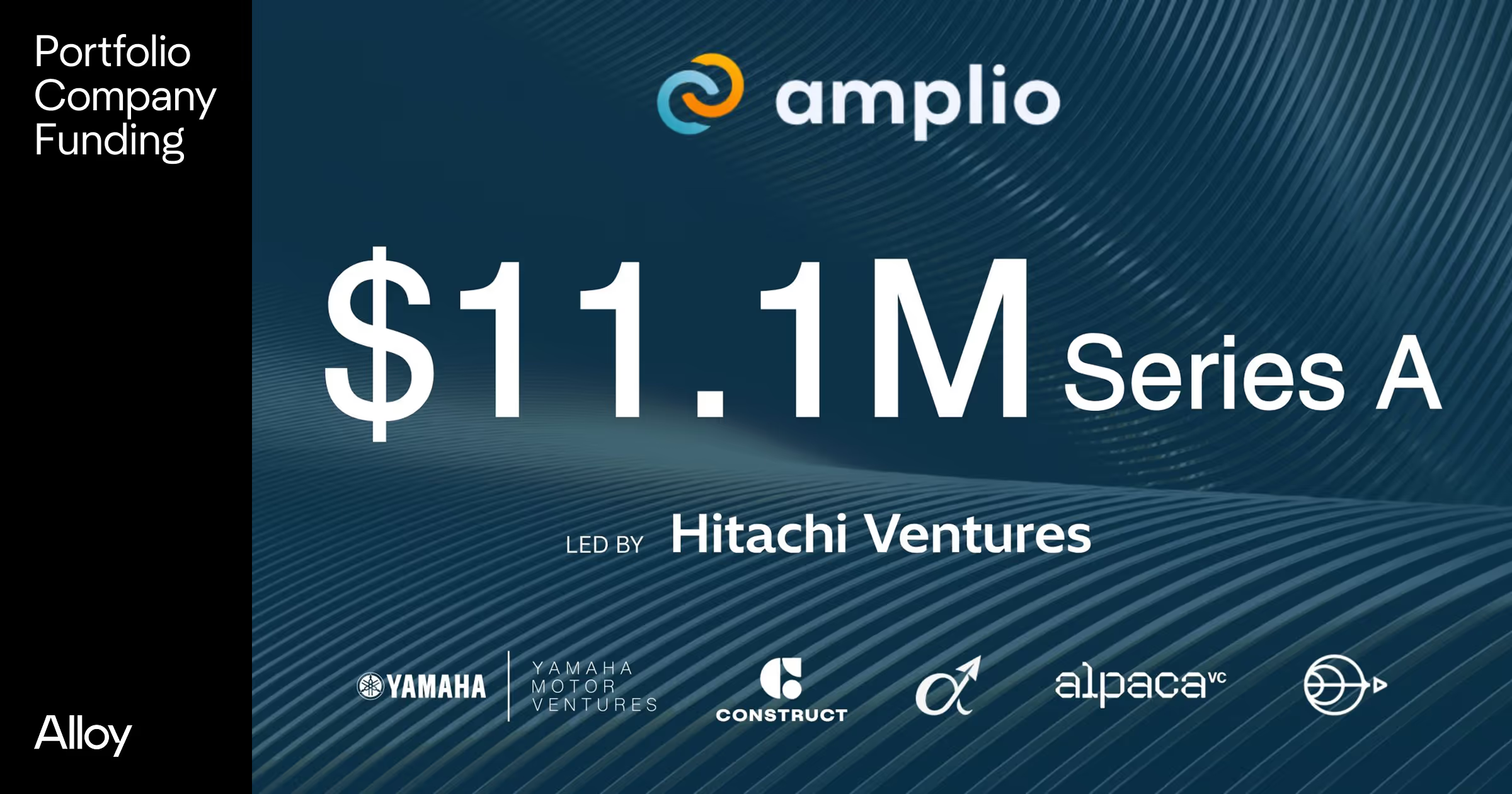
That's a different kind of corporate innovation. Not incremental improvement to what exists, but building new companies with structural resilience from the start. Amplio, co-created by Alloy Partners and a large industrial partner, built a virtual warehouse of industrial inventory that gives manufacturers real-time visibility into at-risk parts. The venture solved a real corporate problem. But it also solved a structural market problem that no one had built a scalable answer for.
That's what venture building looks like when it takes this seriously: a new company, built with a corporate partner who has the domain expertise, the customer relationships, and the assets to give it real advantage from day one, and designed to function under stress, not just under normal conditions.
If your organization is thinking about resilience as a strategic mandate rather than a compliance exercise, let's talk.





















































.avif)