Your data will not save you.
I remember the first time I heard someone say, with a straight face, “We’ll monetize the data.” It was about 20 years ago, in a team meeting for our corporate innovation function, and the phrase arrived right at the end of an otherwise solid pitch, like a magic trick meant to make the business case irresistible. The benefits had been laid out, the financials seemed reasonable, and then came the flourish: “And then…we’ll monetize the data.” Curtain drop, applause expected.
The Comforting Myth of Data
You have probably heard some version of that line, too. Underneath it sits a comforting belief: our data is uniquely valuable, and somewhere inside it, there is a gold mine just waiting to be tapped. The reality is far less glamorous. Most corporate data is either not as unique as people think it is, or not especially valuable outside the context of the company that generated it. If it truly were a differentiated asset, you would see far more liquid, robust marketplaces for that data than actually exist today.
The same wishful thinking now shows up in conversations about AI. There is a popular storyline that big companies will dominate the AI era simply because they are sitting on troves of proprietary data to train models no one else can match. For the vast majority of organizations, this is just a new spin on the old “monetize the data” fantasy. Data monetization has always been hard, for the same reasons it is hard now: your data probably is not as rare or irreplaceable as you want it to be. Yes, data is “the new oil,” but in this analogy, the oil field extends under almost everyone’s backyard.
At the same time, there is mounting pressure for leaders to drive "AI transformation" in their organizations. According to BCG's new research, 50% of CEOs believe their job stability depends on getting their AI strategy right.
The good news is that large enterprises can still win in AI, just not by waiting for some mythical data advantage to do the work for them. They will win by building AI-native businesses that learn faster than the market, and then scaling what those businesses discover.
Three Ways AI Actually Changes Your Business
It helps to put AI into a simple framework for large companies. There are three primary ways AI can be used to create real value inside corporations today:
- To improve efficiency. This is where many organizations already see traction: automating or accelerating internal processes, augmenting knowledge work, and shaving time off routine tasks. Think about coding, faster research, AI assisted sales training, or tools that help teams generate and refine content more quickly.
- To improve the customer experience. Enterprises have been using algorithms for years to personalize recommendations and digital experiences. What is changing is the depth of interaction. The clunky “Press 1 for…” phone tree is quickly becoming a relic as AI enables more natural, dynamic ways to engage customers across channels.
- To create entirely new, AI-driven business models. This is the most difficult and the most important. It requires rethinking what the company is, not just how it operates. These models rarely look like extensions of existing products; they usually sit a few steps removed from the core business, in territory that feels unfamiliar and uncomfortable.
Most corporate AI conversations get stuck in the first two categories. They are safer, easier to justify, and easier to map onto current org charts and budgets. But the biggest upside lives in that third category, where AI is the foundation of an entirely new business, not just an efficiency layer bolted onto an old one. The most reliable way to discover those AI-native businesses is not through slide decks and strategy offsites, but by actually launching AI startups whose sole job is to run experiments and learn.
We Have Seen this Movie Before
To understand where we are with AI, it helps to look backward at other transformative technologies. When the commercial Internet first hit mainstream, many publishers literally put their magazines online as static replicas of the print product. Same layout, same order of pages, sometimes even an animation to mimic the page flip. It was the digital equivalent of filming a stage play straight on: new medium, old mindset.
That pattern of “new technology, old format” shows up every time. Early films looked like theater because filmmakers had not yet internalized what cameras and editing could really do. Only later did the medium evolve into something that could not exist on a stage: cuts, pans, close ups, entirely new ways of telling stories.
We are in that early, skeuomorphic phase with AI today. Most corporate AI initiatives try to graft AI onto existing processes, products, and org structures. It is understandable. When something new shows up, the first instinct is to ask, “How do we apply this to what we already do?” But the truly interesting opportunities are almost never simply “the old thing, but with AI.”
Getting to those opportunities requires a different kind of behavior: running lots of experiments that are fast, cheap, and weird. The best vehicle for those experiments is not another internal tiger team; it is building AI startups that are free to redesign the work from the ground up.
AI is not just another technology wave. It goes right at the thing humans consider their core advantage: thinking. Because of that, even relatively simple AI enabled solutions can demand a radical reworking of how a company makes decisions, moves information, and manages risk. Trying to do that reinvention entirely inside the existing structure tends to produce AI initiatives that look like films shot as if they were plays. Building AI-native ventures on the outside gives you permission to shoot a completely different kind of movie.
Why You Need Experiments Outside the Core
When you attempt to build AI-enabled offerings inside a large enterprise, you inherit all of its incentives, constraints, and habits. Those forces are great at protecting and scaling what already works, but they are terrible at supporting fragile, unproven experiments. Even when teams are told to innovate, the implicit message is: “Be creative, but do not endanger what we already have.”
That is why, in many cases, the best way to discover transformative AI applications is to build outside the corporation, in the form of AI-native ventures and startups. Startups are designed to behave differently. They operate with a different set of rules. They move quickly, chase learning, and accept that most of what they try will not work the first time. Their job is to run experiment after experiment until a repeatable model emerges. They are built for learning.
Large companies, by contrast, are designed to do almost the opposite: execute at scale, reduce variance, and avoid visible mistakes. That is exactly what you want once you know what works, but it is a terrible environment for discovering what works in the first place.
So if you are serious about “AI transformation,” you are really talking about a transformation of your business model, not just your tech stack. That kind of transformation does not happen because you implemented a new system or bought a better tool. It happens because you launched AI-native startups that explored the edges of your value chain, found entirely new ways to create and capture value, and then fed those learnings back into the core.
Concrete Examples: Revisto and vflok
A couple of years ago, we partnered with a top pharmaceutical company to launch a startup focused on one of their thorniest challenges: the legal and regulatory review of marketing materials. If you have ever worked inside a highly-regulated industry, you know how painful that process can be: slow, expensive, and full of necessary checks that still end up frustrating everyone involved.
For years, this company had tried to streamline that review flow from within, using the usual toolkit of process improvements and technology upgrades. Progress was limited. The internal machinery of the organization made a step-change improvement very hard.
Together, we took a different path and launched a new venture, Revisto, built from the ground up around an AI-enabled workflow for review. Our partner took a minority equity position and became the first customer, while the startup was free to move at its own pace and design a workflow that made sense for the work, not for the org chart.
In a short period of time, Revisto delivered a working solution and gave the corporate partner a front row seat to how AI could reshape a critical, regulated workflow. That is what AI transformation looks like in practice: a focused, AI-native startup that experiments quickly in the market, then brings back a proven model the enterprise can scale.
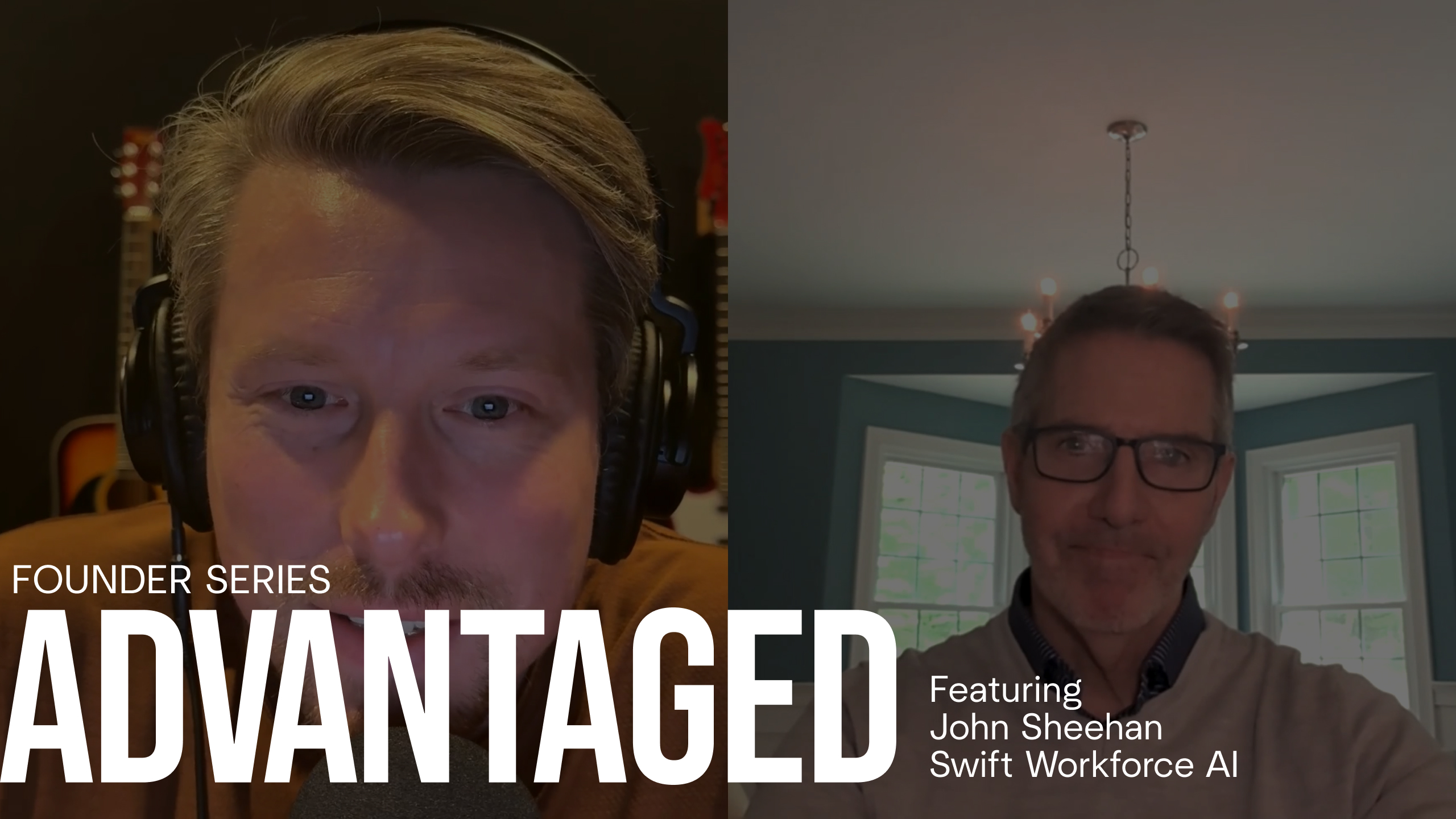
Healthcare offers another clear example of how AI-native ventures can drive deep change. Together with Wellstar Health System and its innovation arm, Catalyst by Wellstar, we co-created vflok, a workforce AI startup built around one very human problem: nurse staffing and scheduling.
Nurse managers and frontline teams have long relied on manual workarounds like spreadsheets, group chats, and phone calls to fill open shifts and juggle last-minute changes. Rather than trying to bolt AI onto existing scheduling tools inside the health system, vflok started fresh, designing an AI-native product, Swift, an AI Scheduling Copilot, that sits on top of existing systems and handles the messy coordination work.
In a six-month pilot at three Wellstar hospitals, Swift reduced change management time-on-task for nurses and support staff and dramatically reduced the time nurse managers spent managing the schedule, while more than 98% of users interacted with it through simple SMS or chat. The result is that nurse leaders spend less time wrestling schedules and more time on patient care and team support, and nurses spend less time fighting workflows and more time doing the work they signed up to do.
Today, Wellstar is scaling Swift across its 11 hospitals to support thousands of nurses and additional non clinical staff. That is not a lab experiment or a slide in a transformation roadmap. It is an AI-native startup, built in partnership with a major health system, rewiring a mission-critical workflow in production and, in the process, redefining how workforce management works in healthcare.
Startups as Experiment Engines
What Revisto and vflok illustrate is a broader point: startups are experiment engines. Their purpose is to search, not to optimize. They test hypotheses, throw away what fails, double down on what works, and keep moving until they find a model worth scaling.
Big companies, on the other hand, are scale engines. They excel at rolling out proven models across geographies, channels, and product lines. They know how to manage risk at scale, coordinate large teams, and deliver consistent outcomes. You need both capabilities, search and scale, but you rarely get them in the same structure at the same time.
If you want to uncover AI applications that do more than shave a few percentage points off costs, you have to accept that you are going to make a lot of small, cheap mistakes. That is what experimentation is. The question is not whether those mistakes will happen, but where they will happen, how much they will cost, and how quickly you will learn from them.
Launching AI ventures outside the core is one of the most effective ways to manage that tradeoff. You create room for fast, unconstrained exploration, while still keeping a tight connection back to the mothership through ownership, commercial agreements, and shared learning. In other words, you turn AI from a buzzword into a portfolio of live experiments that are actively rewriting your business model.
How Big Companies Win the AI Race
If you are a leader inside a large organization, and you are serious about AI, the mandate is clear: start building. Not just pilots tucked away inside business units, but AI ventures that are free to challenge your assumptions and redesign how value is created.
You should be asking:
- Where can AI fundamentally change the economics or speed of our most important workflows?
- Which problems are so entrenched internally that we are better off attacking them with a fresh structure and incentives?
- What AI-native businesses could exist because of our market insight, relationships, and assets, but do not naturally fit inside our current business model?
Then you go launch companies to explore those questions. You make sure they can move at startup speed. You accept that many of them will evolve into shapes you did not predict. And you build mechanisms to pull the resulting insights, capabilities, and products back into your scaled business when they are ready.
Large enterprises are not going to win the AI race because they have the most “unique” data. They will win if they combine three real advantages:
- Deep understanding of their markets and customers.
- Privileged access to distribution and relationships.
- The ability to apply successful models at massive scale once they are discovered.
But you cannot scale what you have not yet learned. The learning has to come first, and learning requires experiments, many of which are best run as AI-native startups, built in partnership but outside your four walls.
Meanwhile, venture backed competitors and ambitious founders are already working on AI startups designed to replace key pieces of your value chain. They are well funded, they move fast, and they are not burdened by legacy systems. They are running the experiments that will define your industry’s future.
You do not have time to sit back and hope that “monetizing the data” will somehow save you. Go build the experiments, in the form of new ventures, and start learning at startup speed before someone else does it for you.
If you're interested in exploring new AI-native ventures, reach out.













































.avif)