
Look across the Fortune 500. You’d be hard-pressed to find a scaled enterprise without an innovation strategy.
Whether it’s executed solely with research and development resources, an innovation team with a dedicated Chief Innovation Officer, or outside help (consultants, partners, research labs, etc.), a well-crafted innovation strategy can strengthen the core business and help identify new business opportunities.
Corporations clearly see the value of creating an innovation strategy tied to their overall business strategy.
But with the business environment constantly and rapidly changing, the types of innovation strategies that lead to long-term success for enterprises continue to change, requiring these companies to adapt.
That begs the question, though:
How can large companies continually modify their innovation initiatives to align those innovation efforts with the needs of existing business models and goals and future business opportunities?
Let's explore what the modern innovation strategy entails for today's corporations and zero in on what specific kinds of innovation programs can move the needle for their company today and prepare them to thrive tomorrow.
What is an innovation strategy?
An innovation strategy involves ongoing experimentation, either solely within a business or with the aid of an external partner, to find ways to improve, expand, or augment existing products and services or to create entirely new business models or offerings.
No two innovation strategies look exactly alike. But the goals are the same:
- Drive growth and efficiencies near term
- Future-proof the organization long term
A corporate innovation strategy is important because it helps large enterprises:
- Stay one step ahead of others in their industry/vertical and gain a competitive advantage
- Conduct quick, cheap tests tied to and away from the core business at scale, based on hypotheses, internal and external research, and perceived market opportunities
- Deliver greater value to high-value customers and partners to maintain trust and loyalty
By constantly experimenting with new business ideas and concepts and embracing ongoing process and technological innovation, corporations can maintain their market share, better empower company-wide (e.g., execute smarter sales and marketing strategies, streamline customer success workflows)
"The innovator's dilemma says that executives can do everything right, serving their best customers and doing it ever-more profitably, but their businesses will ultimately fail," Alloy Partners CEO Elliott Parker recently explained on Powderkeg's Get IN podcast.
Elliott said that's because, as these corporations move upmarket to serve existing customers, they "leave themselves exposed at the lower end to new entrants who come in with good enough products, grab a foothold, and then move upmarket themselves and displace those incumbents. It's a really hard problem to solve."

Benefits of an innovation strategy
At a deeper level, a well-designed innovation strategy enables corporations to:
Tackle problems and risks outside of the core
Roughly one-quarter (23%) of corporate executives told Fast Company their companies' R&D budgets and programs accounted for 15% or more of their organizations' revenue in 2023. Not surprisingly, more than half (54%) of these leaders planned to increase R&D budgets as a result.
Core business innovation is always vital. But more enterprises are realizing the pros of innovating beyond the core.
Consider corporations launching startups.
Venture building (and, more specifically, the venture studio model) enables them to explore new business models and build their own companies that solve big problems of interest to them.
Become more adaptable and resilient as a business
In 2025 and the years ahead, there is likely to be "continued geopolitical upheavals," MIT School of Management Associate Dean of Innovation Fiona Murray recently noted. "For leaders focused on innovation, this means shifting priorities to build more resilient supply chains and production systems," she stated.
In other words? A future-focused innovation strategy can enable corporations to predict and react effectively to 'black swan' events like the COVID-19 pandemic to keep core business operations running smoothly.
Boost team productivity, efficiency, and output
Artificial intelligence and automation continue to transform day-to-day work of the modern corporate workforce. But it's only when corporate executives encourage innovation tied to this tech that their companies see greater operational efficiencies and, in turn, stronger financial results for the business.
"Business leaders who succeed in digital and AI transformations are completely rewiring their organizations" for the better, McKinsey noted. That includes making employees work smarter, not harder, and realize greater productivity.
This streamlined work leads to better output; the elimination of manual, repetitive tasks; and faster time to ROI.
Innovation comes in several types, from incremental improvements to the core to transformative bets on new business models. We break those down in our guide to corporate innovation. The harder question is not which type to pursue, but how to resource the pursuit, which is what the rest of this guide covers.

Developing an innovation strategy
Knowing where to start with creating a new innovation strategy or revamping an existing one can be daunting. Regardless of the exact innovation approach chosen, though, corporate innovation teams are best served by beginning with the 'basics': creating systems that enable efficient, continuous testing.
"Innovation teams need to be focused on gathering as many insights as they can," Elliott said on the Inside Outside Podcast. "You do that by running as many experiments as you can at the lowest possible cost per experiment because you don't know ahead of time which experiments or which insights are going to lead to the breakthroughs."
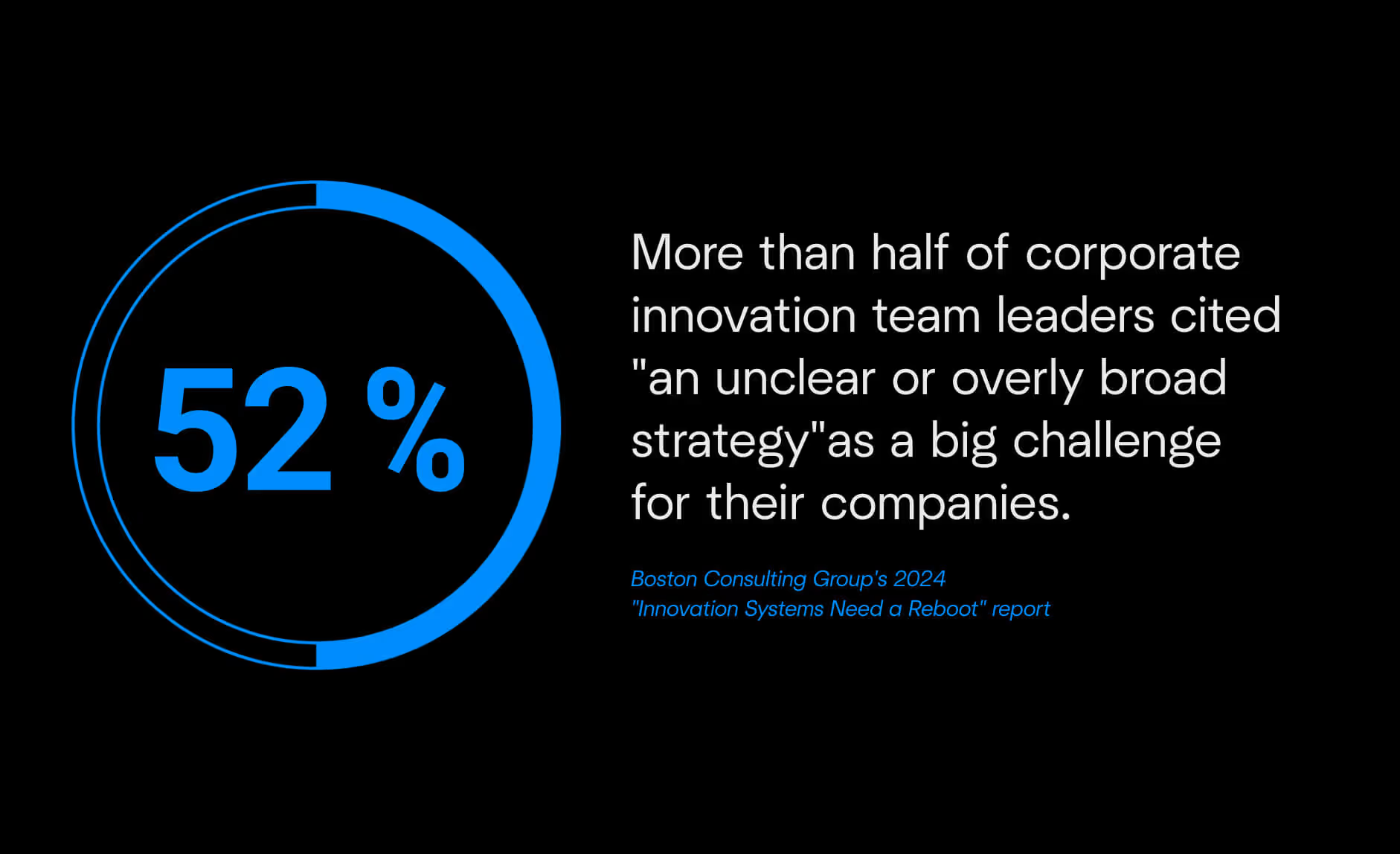
With "innovation readiness" declining in recent years, per Boston Consulting Group, it's essential for C-suites and their innovation teams to recognize the rewards they can reap through well-coordinated innovation programs by:
- Leveraging both proprietary and market data to generate, evaluate, and advance ideas
- Broadening their innovation portfolio beyond just corporate venture capital investments
- Turning to external partners, like outside venture builders, for open innovation assistance
- Selecting thoughtful, relevant innovation themes that dictate the opportunities to explore
- Defining realistic yet ambitious goals and clear metrics to determine innovation success
- Giving innovation teams the budget, personnel, and psychological safety needed to excel
In his book, "The Illusion of Innovation," Elliott notes corporations fail to execute innovation strategies that provide meaningful, tangible results. In turn, "many of these businesses are not prepared to face the future, and are in greater peril than they seem, even if they don’t yet realize it," he noted.
The best way to avoid this innovation theater is to pick a lane (i.e., strategic North Star) and allocate the necessary resources to enable innovation teams to unearth new learnings and anomalies that can drive the business forward.
Listen to our episode of Advantaged to discover the common failure modes of modern corporate innovation.
Innovation strategy consulting vs. building the function
When companies go looking for help with an innovation strategy, most of what is on offer is innovation consulting: a firm that studies the problem and hands back a recommendation. That is useful for the analysis. It does nothing about the resourcing problem that actually kills strategies.
The distinction that matters: a consultant tells you what your innovation strategy should be. A builder stands up the strategy, the team, and the operating model that runs it, and stays accountable for whether it produces.
How Alloy stands up innovation strategies, teams, and functions
Alloy Partners is a venture builder, not a consultancy. We help corporations do more than write an innovation strategy. We stand up the function that executes it.
That means designing the strategy and the operating model together: the bets, the funding mechanism, the governance, and the portfolio approach, built so the work can actually run. Where a company needs it, we help build and staff the team, and in many cases we co-create the new companies alongside it through a corporate venture studio, putting our own capital and people into the build.
Across 35+ companies and 8+ studios with partners including Elanco, Capital One, and Huntington Bank, the pattern holds that the strategies that produce are the ones that came with a function attached. The rest never got past the plan.
If your innovation strategy keeps stalling at the plan, the missing piece is almost certainly execution capacity, not a better plan.
Start with the argument. Elliott Parker's book, The Illusion of Innovation, lays out why efficient companies struggle to innovate and what to do about it. You can download the free audiobook here if you'd like to listen to the book. Or if you are ready to stand up the function, talk to our team.









































































.avif)